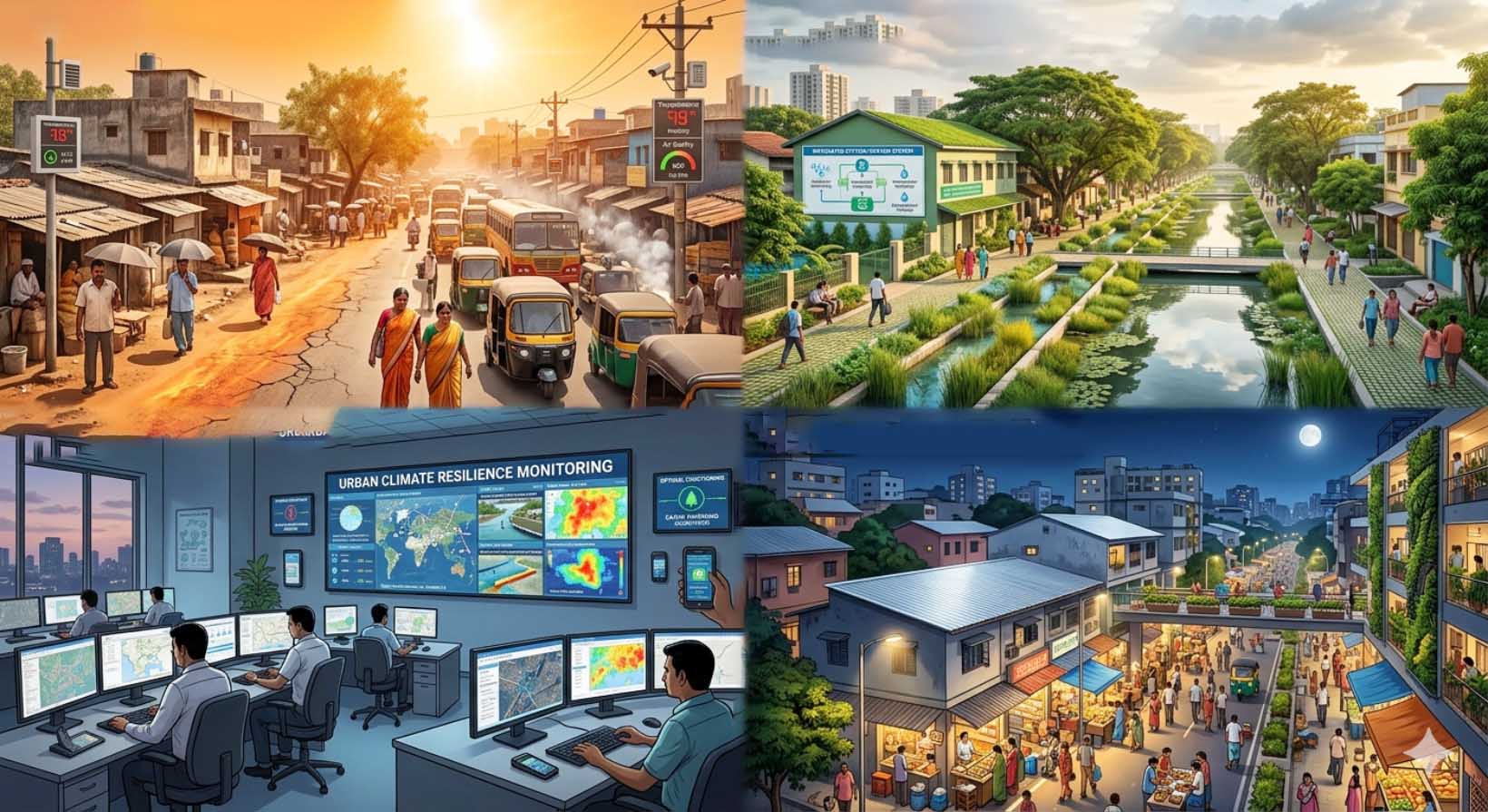
On a humid afternoon in Dharavi, the tin roofs trap heat like an oven. By noon, stepping inside a one-room home feels suffocating. Across the city, dark clouds gather over the Arabian Sea, threatening another spell of flooding that could paralyze streets within hours.
From Mumbai’s flooded roads to Bengaluru’s water shortages and Delhi’s searing heatwaves, India’s cities are confronting a dangerous convergence of climate extremes. Scientists and urban planners warn that without urgent adaptation, the country’s fast-growing urban centers could become increasingly unlivable.
India’s urban population is expected to cross 40% by 2030, adding millions to cities already struggling with strained infrastructure. Much of this growth is happening in peri-urban areas—regions where planning is weak, services are limited, and climate risks are high.
“It’s no longer about whether climate change will impact cities,” says an urban climate researcher involved in multiple city-level assessments. “It’s about how prepared we are—and right now, that preparedness is uneven.”
A triple threat
Experts point to three major risks reshaping urban India: extreme heat, frequent flooding, and growing water stress.
Heatwaves have become longer and more intense. In dense neighborhoods with little greenery, temperatures can feel several degrees higher than official readings. For outdoor workers—construction laborers, street vendors, delivery riders—the consequences are immediate and severe.
Flooding presents a different but equally disruptive challenge. Cities like Chennai and Kolkata face repeated inundation during monsoons, often due to clogged drainage systems and the disappearance of natural wetlands. Roads turn into rivers, transport systems shut down, and economic activity stalls.
At the same time, water scarcity continues to worsen. Bengaluru, once known for its lakes, now relies heavily on water tankers as groundwater levels fall. The irony is stark: cities that flood during heavy rains often run dry months later.
Patchwork responses
Many cities have begun responding, but efforts remain fragmented.
Heat action plans have been rolled out in several urban centers, introducing early warnings, cooling shelters, and public advisories. Flood forecasting systems and storm-water projects are also being developed, often with international support.
Yet these initiatives are frequently reactive rather than preventive.
“Most interventions still come after a disaster,” says a planner who has worked with multiple municipal governments. “We fix what broke, but we don’t redesign systems to withstand future risks.”
Even where technology is available, institutional gaps limit its effectiveness. India’s Smart Cities Mission has established control centers capable of monitoring urban systems in real time. But experts caution that data alone cannot drive change without coordinated governance and long-term planning.
The human cost
Climate risks do not affect all residents equally.
In informal settlements, where housing is often poorly insulated and access to water is limited, the impact is far more severe. A heatwave can turn a small dwelling into a life-threatening space. Floods can destroy livelihoods overnight.
Urban planners say that current adaptation strategies often overlook these vulnerabilities.
“Advisories and emergency measures are important,” says an environmental economist tracking climate policy. “But they don’t address why certain communities are more exposed in the first place.”
For many, the risks are tied directly to where they live and work—areas shaped by affordability rather than safety.
Rethinking urban design
A growing number of experts argue that adaptation must be built into the very design of cities.
This includes protecting wetlands, increasing green cover, and adopting water-sensitive planning that integrates drainage, storage, and reuse. It also means rethinking building materials, street layouts, and public spaces to reduce heat exposure.
Some cities are experimenting with these ideas. Cool roofs, urban forests, and decentralized water systems are being tested as scalable solutions. But progress remains uneven, and implementation is often slow.
A critical decade
The coming years will be decisive.
As cities continue to expand, the choices made today will determine how they withstand future climate pressures. The line between development and adaptation is rapidly blurring—every road, building, and drainage system must now account for a changing climate.
“Urban India doesn’t have the luxury of choosing between growth and resilience,” says a policy expert at a national institute. “They have to happen together.”
Back in Mumbai, the skies finally open. Rain pours down, flooding streets within minutes. For residents, it is a familiar scene—one that underscores a growing reality.
India’s cities are no longer preparing for climate change. They are already living through it.
Why Heat Action Plans Fail
- Seasonal focus, not year-round strategy
- Weak funding and unclear budgets
- Limited coordination between agencies
- Poor integration with housing and labour policies
- Lack of data-driven monitoring systems
Solutions That Work
- Cool roofs and reflective materials
- Urban forests and shaded corridors
- Wetland restoration and flood buffers
- Decentralised water management systems
- Community-led climate planning initiatives
The funding challenge
Financing adaptation remains a major hurdle.
While many solutions are technically feasible, they require upfront investment and long-term commitment. Municipal budgets are often limited, and private investment is cautious due to unclear project structures.
Experts say innovative financing—such as green bonds and public-private partnerships—will be essential to bridge the gap.
(With Inputs: Kundan Krishnan, IPS)