By Srishti Aggarwal
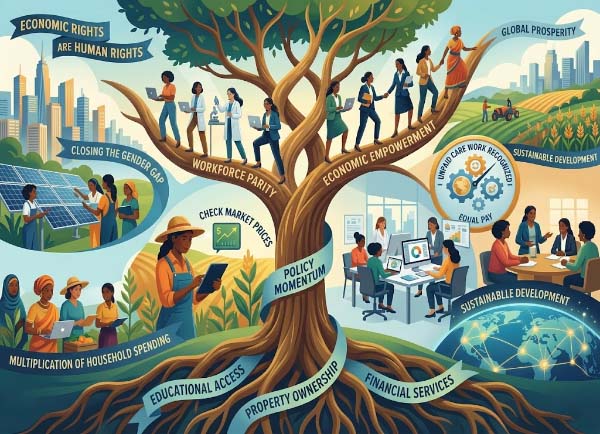
Women’s economic rights—equal access to work, pay, property, finance and social protection—remain one of the most decisive yet under-realized drivers of global prosperity. Enshrined in frameworks such as the Universal Declaration of Human Rights and the Convention on the Elimination of All Forms of Discrimination Against Women, these rights underpin equitable development. Yet implementation gaps persist across regions, limiting women’s participation in formal economies and constraining growth.
At its core, economic empowerment extends beyond employment to control over income, assets and financial decisions. For girls, this begins with access to education and skills that prevent early marriage and workforce exclusion. Globally, however, women continue to shoulder roughly three-quarters of unpaid care work—an invisible burden that restricts labor participation and reinforces economic dependency.
Persistent global gaps
Despite decades of reform, disparities remain stark. Data from the World Bank show women enjoy only about two-thirds of the legal rights afforded to men. No country has achieved full parity.
Labor force participation among women lags men by more than 25 percentage points globally, with many confined to informal, low-wage sectors. Wage inequality persists, with women earning about 20–25 percent less than men on average. These structural gaps translate into weaker savings, lower pensions and heightened vulnerability in old age.
In India, the pattern reflects broader global trends. Female labor force participation remains below potential despite flagship programs such as Beti Bachao Beti Padhao. Women account for a small share of formal employment, while dropout rates among girls rise after primary education due to domestic responsibilities.
Legal and institutional barriers
Legal frameworks continue to shape economic exclusion. In many countries, inheritance laws favor male heirs, restricting women’s ownership of land and assets—key prerequisites for accessing credit. Even where reforms exist, cultural norms often blunt their impact.
Workplace barriers compound the challenge. Limited maternity protections, lack of affordable childcare and persistent harassment discourage women’s workforce participation. According to analysis by the International Monetary Fund, gender gaps in labor and productivity have cost the global economy tens of trillions of dollars in lost wealth.
In India, amendments to inheritance laws have expanded women’s rights on paper, but enforcement remains uneven. Social norms and procedural barriers continue to limit women’s claims to property and financial independence.
Lessons from the field
Global experience offers both cautionary tales and models of progress. Rwanda stands out for integrating gender equality into post-conflict reconstruction, enabling women to secure property rights and expand entrepreneurship. The result has been measurable gains in productivity and economic growth.
In contrast, policy reversals in Afghanistan have sharply curtailed women’s access to education and finance, with significant economic fallout. Meanwhile, reforms in Saudi Arabia—including lifting restrictions on women’s mobility—have boosted female labor participation, though broader structural constraints remain.
India’s own experience is mixed. Grassroots organizations such as the Self-Employed Women’s Association have demonstrated the transformative power of collective bargaining and financial inclusion, raising incomes for millions of informal workers. Yet women-led enterprises continue to face disproportionate barriers in accessing capital.
The economic case
The macroeconomic argument for gender parity is compelling. Estimates suggest closing gender gaps could add up to $25–30 trillion to global GDP over the next decade. Women’s increased earnings tend to translate into higher household spending on education, health and nutrition, creating multiplier effects across generations.
Unpaid care work—valued in the trillions annually—remains a critical constraint. Policies such as paid parental leave, childcare infrastructure and flexible work arrangements can help redistribute this burden and unlock labor supply. For girls, each additional year of schooling significantly boosts lifetime earnings, reinforcing the link between education and long-term economic mobility.
Policy momentum and innovation
Multilateral initiatives are scaling up efforts to bridge gender gaps. Programs backed by the United Nations and the World Bank are expanding access to finance, entrepreneurship and digital tools for women.
Technology is also playing a catalytic role. Mobile banking platforms in Africa and South Asia have dramatically increased financial inclusion, enabling women to save, invest and manage risk independently.
In India, government schemes such as Stand-Up India and rural employment programs have improved access to credit and wages, though structural inequalities persist. Local governance reforms, including reservations for women in panchayats, have strengthened political and economic agency at the grassroots level.
The road ahead
Closing gender gaps will require coordinated action across legal, economic and social domains. Priorities include enforcing equal pay, expanding childcare infrastructure, ensuring property rights and investing in digital and STEM education for girls. Financial systems must also evolve to better serve women entrepreneurs, moving beyond microcredit toward scalable capital solutions. At the same time, robust data systems are needed to track progress and hold institutions accountable.
An unfinished agenda
The push for women’s economic rights faces new challenges—from automation displacing low-skill jobs to climate change disproportionately affecting women in agriculture and informal sectors. Social backlash and policy reversals in some regions underscore the fragility of recent gains.
Yet the broader trajectory remains clear. Economies that fail to integrate half their population into productive activity risk stagnation, while those that do stand to unlock unprecedented growth.
The case for action is no longer just moral-it is economic. Empowering women is not a peripheral agenda but a central strategy for sustainable development in the 21st century.