New Delhi: At 8 AM, the familiar signature tune rises softly through transistor radios, car dashboards and government offices across India. A calm, measured voice follows. The bulletin is flawless — every pause controlled, every syllable precise. For millions of Indians, that sound still carries authority. It is the sound of Akashvani — India’s public broadcaster, once known simply as All India Radio — the institution that has narrated wars, elections, disasters, parliamentary upheavals and national triumphs for generations. But behind the polished bulletins and ceremonial broadcasts lies another story, one rarely heard outside the corridors of the newsroom itself.
The people who keep India’s most trusted radio network alive are, in many cases, workers without permanence, social security or institutional protection. They are the invisible newsroom army of Prasar Bharati — contractual announcers, translators, copy editors and news readers who have spent years, sometimes decades, serving a system that still treats them as temporary.
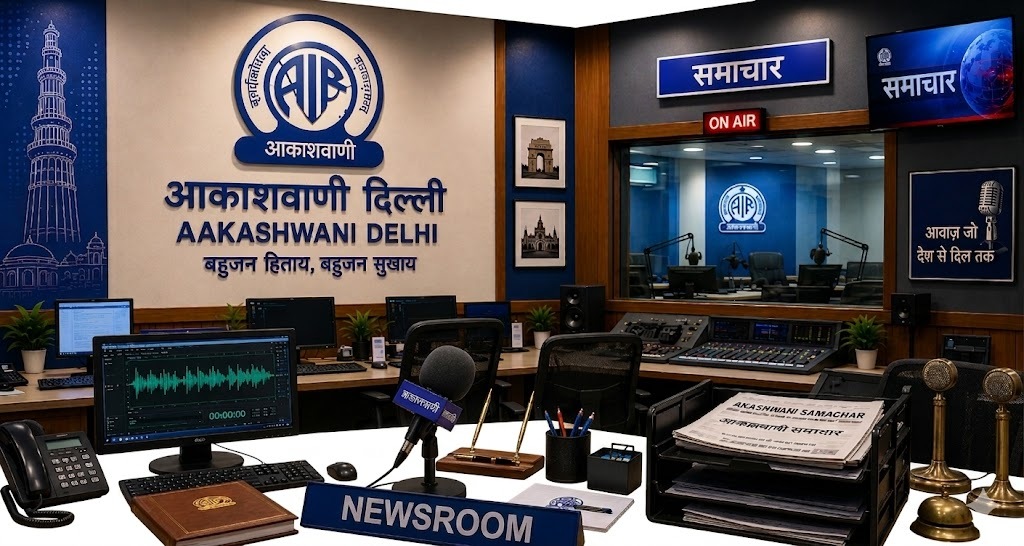
The News Services Division in New Delhi does not operate like an ordinary office. It breathes in shifts. News breaks at midnight. Government advisories arrive before dawn. Prime ministerial speeches require instant translation into multiple languages. International developments have to be rewritten for Indian audiences within minutes. The newsroom runs continuously — 24 hours a day, seven days a week. Inside, monitors flicker under fluorescent lights while exhausted editors move between script terminals and recording booths. Tea cups pile up beside stacks of marked-up bulletins. Deadlines arrive every hour. Yet the overwhelming majority of people managing this machinery are not permanent employees.
According to multiple staff members and internal representations reviewed by this correspondent, between 90% and 98% of operational newsroom workers are contractual or casual assignees. Many have worked there for 10, 15 or even 20 years. Officially, however, they remain temporary, renewed periodically through empanelment systems and short-term contracts — an arrangement workers describe as institutionalized uncertainty. “We are trusted to speak to the nation,” one senior contractual broadcaster said quietly, “but not trusted enough to be made permanent.”
The contradiction has become difficult to ignore. The union government has aggressively promoted labor formalization, digital employment tracking and expanded worker protections under new labor codes. Ministries routinely emphasize social security inclusion for the unorganized workforce. But employees say the country’s own flagship broadcaster functions on a deeply informal labor structure. Many contractual workers claim they perform the same duties as permanent staff — reading national bulletins, editing copy, translating speeches and monitoring breaking news — without the benefits available to regular employees. No provident fund. No gratuity. No guaranteed medical support. No retirement security.
For younger recruits, the uncertainty creates anxiety. For older workers, it creates fear. Several staff members nearing retirement age said they have spent the prime years of their careers inside Akashvani studios with little financial safety beyond monthly payments. A medical emergency, one worker said, could erase decades of savings overnight. And unlike freelancers in the private media industry, many of these professionals entered the system through formal examinations, voice tests and interviews conducted for sanctioned positions. That is what makes the frustration sharper. “This is not informal hiring through the back door,” a former employee said. “People were selected through proper processes. But the system never fully absorbed them.”
Older employees recall a different newsroom culture. Senior officers from the Indian Information Service once sat physically on newsroom floors during major shifts, supervising scripts, mentoring younger editors and correcting errors before bulletins went live. Those veterans were feared, respected and constantly present. Today, staff members say that editorial ecosystem has thinned dramatically. Several workers described shifts with limited senior supervision and increasing dependence on remote approvals over phones and messaging platforms. Into that vacuum has entered a younger, overstretched workforce. Fresh diploma holders and newly recruited information assistants are often assigned heavy editorial responsibilities with minimal institutional guidance, according to employees.
And increasingly, workers say, technology is filling the gap left by shrinking mentorship. Inside the newsroom, employees have begun referring to it half-jokingly as the “ChatGPT culture.” AI-generated summaries, rewritten agency copies and machine-assisted scripts are quietly becoming part of daily workflow pressures. In moderation, newsroom automation is hardly unique to Akashvani. Media organizations worldwide are experimenting with generative AI.
But employees warn that in a public broadcaster — where tone, accuracy and political sensitivity carry national consequences — weak editorial oversight can become dangerous. A mistranslated diplomatic line, an inaccurate attribution or an unverified AI-generated phrase slipping into a bulletin can undermine the credibility of a broadcaster whose greatest asset is public trust.
The tragedy of Akashvani’s labor crisis is not visible on air. Listeners hear composure. They do not hear the anxiety of workers waiting for contract renewals. They do not hear the broadcaster wondering whether decades of service will end without pension or healthcare. They do not hear the editor calculating whether a family illness can be financially survived. Inside the newsroom, some workers joke bitterly that their voices are recognized across the country while their identities remain invisible within the institution itself.
Many still stay because of what Akashvani represents. For older broadcasters, it remains a matter of prestige — a sacred space in Indian journalism where diction mattered, verification mattered and public broadcasting still carried moral weight. Even today, in remote districts where internet signals collapse and television penetration remains weak, Akashvani remains a primary source of credible information. That legacy continues to survive largely because of workers who say they themselves remain institutionally unprotected.
The crisis unfolding inside Akashvani is larger than a labor dispute. It raises uncomfortable questions about the future of India’s public broadcasting infrastructure itself. Can a national broadcaster built on institutional trust continue to depend almost entirely on insecure labor? Can editorial quality survive without long-term investment in experienced newsroom professionals? And can a state-funded media institution champion public accountability while thousands within its own ecosystem remain outside basic social protection? For now, the bulletins continue uninterrupted.
The signature tune still plays. The microphones still switch on every hour. And somewhere inside the newsroom, another contractual broadcaster adjusts a script, clears their throat and prepares to deliver the next authoritative voice of the nation — uncertain whether the institution they serve will ever truly recognize them.