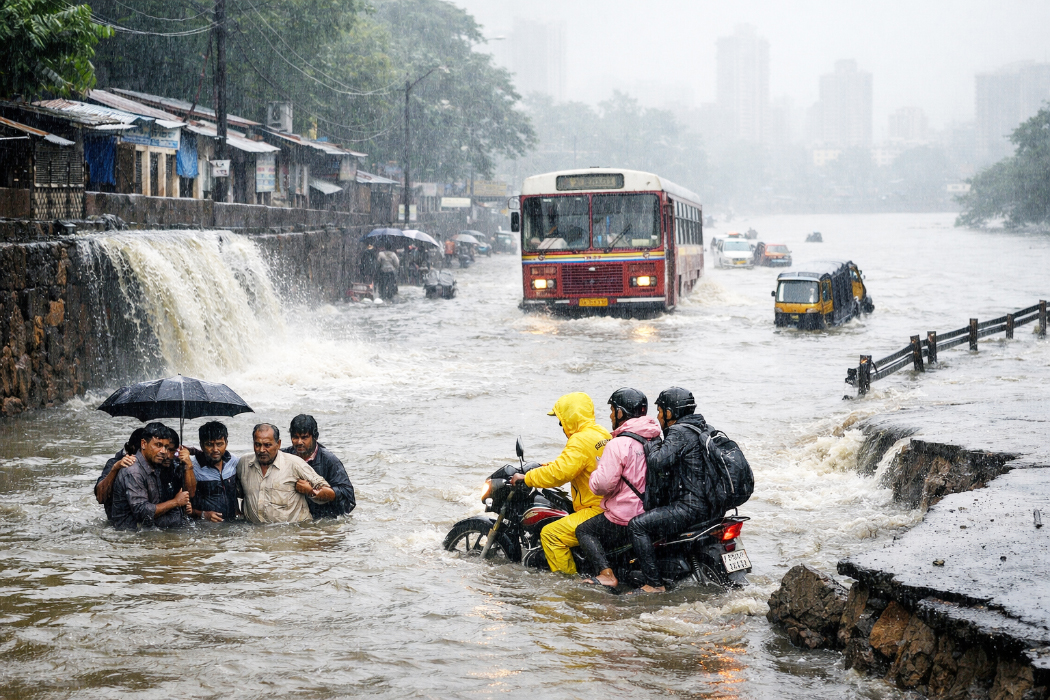
 On paper, Mumbai is a model of urban modernity. Sensors track traffic. Apps deliver services. Control rooms glow with real-time data. But when monsoon rains overwhelm the city — as they did repeatedly in 2023 and 2024 — the illusion cracks. Streets flood, trains halt, and entire neighborhoods are cut off.
Across India’s biggest metros, a pattern is emerging: cities are getting smarter, but not necessarily stronger.
From Chennai to Bengaluru, billions of dollars have flowed into “smart city” projects over the past decade. The focus has been on efficiency — optimizing traffic, digitizing governance, improving service delivery. Yet as climate change intensifies monsoons, cyclones and heat waves, those investments are being tested in ways they were never designed for.
When Cyclone Michaung struck Chennai in December 2023, large parts of the city flooded again, reviving memories of the devastating 2015 deluge. In Mumbai, heavier rains have repeatedly exposed aging drainage systems. Bengaluru, India’s tech hub, faces a different crisis: disappearing lakes and clogged stormwater channels that turn even moderate rainfall into urban flooding.
Urban planners and climate experts say the problem is not technology itself, but what cities are choosing to prioritize.
“Smart cities optimize for convenience,” said one urban policy researcher. “Resilient cities plan for disruption.”
A growing climate threat
India’s coastal and southern cities are on the front lines of climate change. Studies show monsoon rainfall is becoming more intense in many regions, increasing the risk of flash floods and infrastructure failure.
In Mumbai, the risks are compounded by geography. Built on reclaimed land and bordered by the Arabian Sea, the city faces rising sea levels alongside heavier rainfall. Much of its stormwater drainage system dates back decades, designed for rainfall patterns that no longer exist.
In Chennai, rapid urbanization has encroached on wetlands and floodplains that once absorbed excess water. The government has turned to large-scale solutions, including a $251 million flood management program supported by the Asian Development Bank. The plan includes upgraded drains, flood-resistant infrastructure and better land-use planning.
But implementation has been uneven, and residents say flooding remains a recurring threat.
Bengaluru’s challenges are shaped by growth. Once known as a city of lakes, it has seen many of those water bodies shrink or disappear under pressure from real estate development. Stormwater systems, often converted into concrete channels, struggle to cope with heavy rains.
A different model in Surat
In western India, the city of Surat offers a different approach.
Two decades ago, Surat faced a disaster that reshaped its future. Floods in 2005 and 2006 submerged most of the city, displacing hundreds of thousands of people and crippling its economy.
In the years since, city officials have focused less on high-tech visibility and more on preparedness.
At the heart of that effort is an early-warning system that links weather forecasts, river-level data and dam operations. Information from automatic weather stations and river gauges feeds into models that can predict flooding up to 48 hours in advance.
Warnings are then pushed out through text messages, social media, sirens and local networks, reaching large parts of the population. Community volunteers and ward-level teams are trained to respond, translating alerts into action on the ground.
The system is backed by institutional coordination, including the Surat Climate Change Trust, which connects local authorities with state and national agencies.
Over time, officials say, the city has reduced the impact of major floods and improved recovery times.
Experts caution that Surat’s model cannot be copied wholesale. It is a smaller city, with different geography and governance structures than megacities like Mumbai. But its core lesson — that resilience depends as much on institutions and communities as on technology — is widely seen as transferable.
Rethinking what “smart” means
The contrast highlights a broader shift underway in urban planning.
For years, India’s Smart Cities Mission emphasized visible upgrades: digital dashboards, surveillance systems and app-based services. While these tools can improve efficiency, they do little to prevent flooding, manage extreme heat or protect vulnerable populations during disasters.
Resilience, by contrast, often involves less visible work.
It means maintaining and upgrading stormwater drains so they do not clog during heavy rains. It means preserving wetlands and lakes that act as natural buffers. It means enforcing land-use rules that keep construction out of high-risk zones.
It also means decentralizing decision-making, allowing local officials and communities to act quickly when crises hit.
In Mumbai, that could include restoring rivers and strengthening coastal defenses. In Chennai, it could mean integrating flood warnings into schools and hospitals while protecting remaining wetlands. In Bengaluru, planners point to the need for large-scale lake restoration and community-based flood preparedness.
The road ahead
As climate risks grow, the gap between “smart” and “resilient” cities is becoming harder to ignore. Technology will remain part of the solution. But without stronger infrastructure, better planning and more responsive governance, experts warn, it will not be enough. The next major flood or cyclone, they say, will not just test a city’s systems. It will test its priorities. For India’s rapidly growing metros, the challenge is clear: move beyond efficiency and build for survival.