

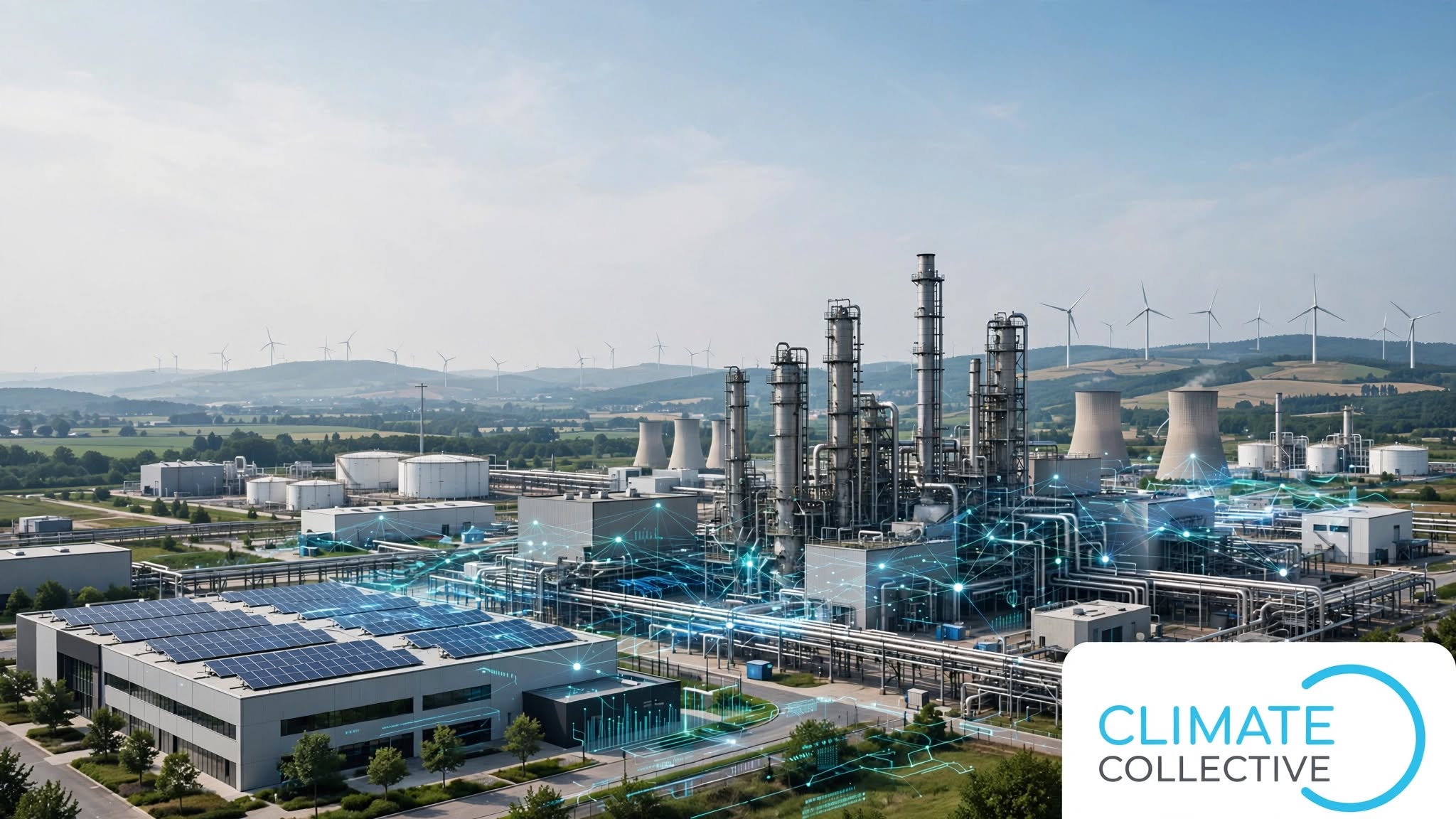
BENGALURU: Artificial intelligence could help industries cut emissions and accelerate their transition to net-zero, but delivering measurable results will require reliable data, closer industry-academia collaboration and wider deployment of proven technologies, experts said at the Industry Net Zero Innovation Summit 2026: AI Edition in Bengaluru.
That was the key message at the Industry Net Zero Innovation Summit 2026: AI Edition, organised by the Climate Collective Foundation through its Climate Challenges initiative as part of Bangalore Climate Data Week.
Held at Sabha in Bengaluru, the summit brought together industry leaders, technology experts, climate-tech startups and other stakeholders to examine how AI can improve operational efficiency, reduce emissions and advance industrial decarbonisation.
During a fireside chat titled “Building the Industry-Academia Interface for Industrial Decarbonisation,” Ankur Gandotra, head of industry-academia partnerships at the Indian Foundation for Quality Management, stressed the need to bridge the gap between academic research and industry’s practical requirements. The discussion was moderated by Dr. Sameer Guduru, senior director of strategic technologies and states engagement at the U.S.-India Business Council.
International cooperation was another focus. In a session titled “Reimagining Global North-South Partnerships for Industrial Decarbonisation,” Rishi Nair, senior specialist for energy transition at Climate Collective Foundation; Dr. Alexander Fisher, director of the International Climate Initiative Interface India; and Akanksha Sharma, head of ClimateTech and Digital Utilities at the GSMA Association, discussed the importance of local context and cross-border collaboration in developing effective climate solutions.
A key session was a debate on the motion, “AI Is an Accelerator of Industrial Decarbonisation.” The panel featured Alexander Hogeveen Rutter, electricity sector lead and manager of research and diligence at Third Derivative; Dr. Rahul Walawalkar, founder and president of the Net-Zero Energy Transition Association; Vijay Balakrishnan, executive vice president and chief digital and information officer at Godrej & Boyce; Avnish Kumar, founder and CEO of LivNSense; and Swetha Ramdas, a climate and sustainability strategy leader and former APAC and AMET sustainability leader at Amazon.
Moderated by Nalin Agarwal, co-founder of Climate Collective Foundation, the debate examined both the promise and limitations of AI in cutting industrial emissions. Supporters argued that AI could deliver near-term reductions in Scope 1 and Scope 2 emissions when backed by reliable data, with some improvements requiring relatively little additional capital investment. Opponents countered that progress so far has been incremental and that AI’s ability to drive the discovery of new climate solutions remains unproven.
The programme also featured startup showcases by Resilience AI and LivNSense, along with roundtable discussions on priority research areas and the use of digital twins to support industrial decarbonisation.
The discussions underscored that AI alone will not deliver the transition to net-zero. Its impact will depend on a stronger ecosystem, including access to capital, adequate infrastructure, skilled workers and the ability to move technologies from validation to real-world deployment.
Alongside the summit, the Climate Collective Foundation hosted Climate Drinks for Women in Data and Climate under its Women in Climate Entrepreneurship initiative, in partnership with Omnivore. The gathering brought together women leaders and allies to encourage networking and peer exchange.
Jui Joshi, a member of Climate Collective Foundation’s founding team, highlighted the importance of creating spaces for women to share experiences and build professional connections.
“For Omnivore, building a strong ecosystem for women entrepreneurs is as important as investing in them,” said Sanskriti Kapoor, vice president of ESG and impact at Omnivore.
The event also marked the culmination of She Wins Climate—South Asia: Startup Showcase 2026, concluding a nine-month, equity-free accelerator programme for women-led climate-tech ventures. Supported by the International Finance Corp., the governments of Canada and Australia, and implemented by MicroSave Consulting and the Climate Collective Foundation, the programme supported 26 women-led startups.
The ventures work across a broad range of sectors, including renewable energy, the circular economy, climate adaptation, food and agriculture, mobility, urban infrastructure, industrial decarbonisation and carbon solutions.