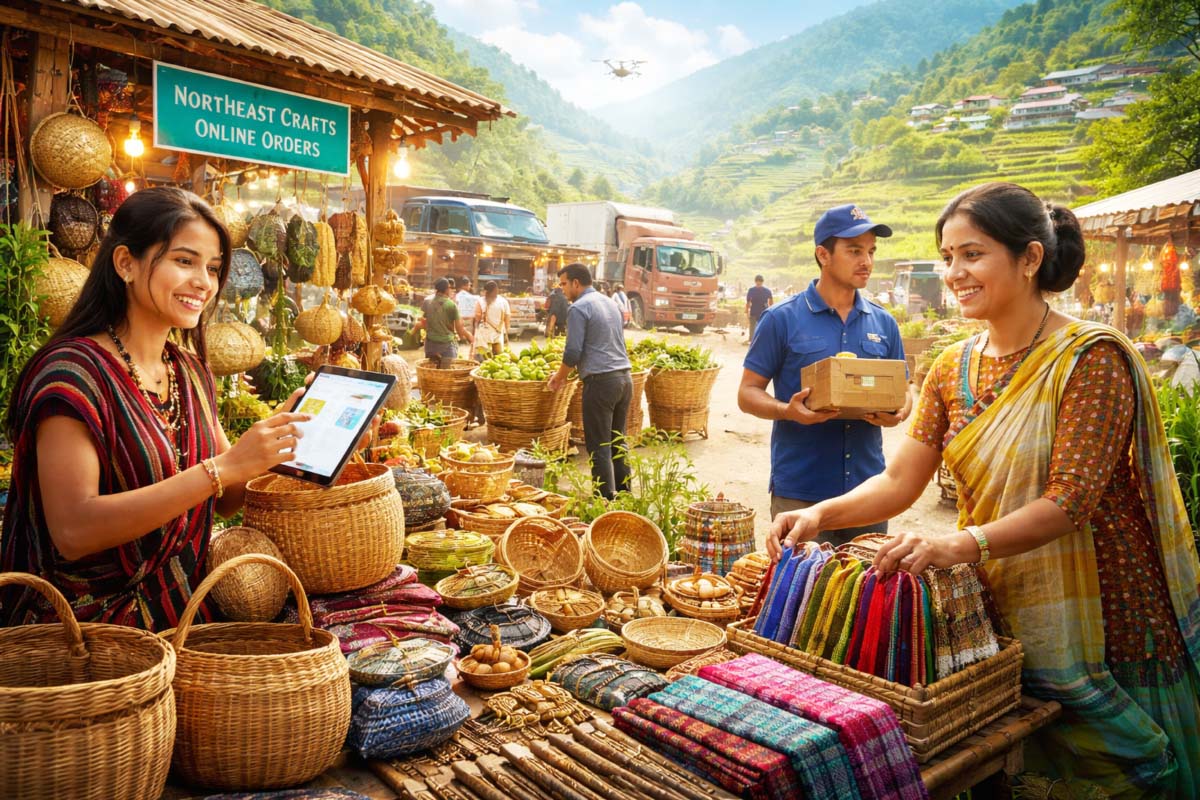
For decades, development discourse around the North Eastern Region (NER) has rightly celebrated its extraordinary craft heritage. From Muga and Eri silk to bamboo artistry and intricate tribal textiles, the region’s handloom and handicrafts sector reflects both cultural identity and sustainable production traditions. Yet despite this richness, the sector continues to operate largely at the margins of organized retail and global trade.
The central challenge is not a lack of skill. Nor is it a lack of demand. It is the absence of a structured market ecosystem.
Across Assam, Manipur, Meghalaya, Nagaland, Tripura, Arunachal Pradesh, Mizoram and Sikkim, thousands of artisan clusters produce high-quality handcrafted goods. But production remains fragmented, informal and disconnected from organized supply chains. Products are often sold through exhibitions, fairs or local markets, with limited access to standardized packaging, barcoding, digital cataloguing or international compliance certifications.
In today’s global marketplace, craftsmanship alone is not enough. Market access requires aggregation systems, quality control protocols, export documentation support, branding expertise, logistics coordination and digital commerce integration. Without these institutional supports, artisan communities remain trapped in low-margin value chains.
This is where a structured intervention led by the Ministry of Development of North Eastern Region can make a decisive difference.
A comprehensive market connectivity and skill ecosystem would move beyond the traditional cluster-development model. Instead of focusing solely on production enhancement, it would build end-to-end value chain integration — from design incubation and compliance training to centralized quality hubs, export facilitation cells and e-commerce onboarding.
Such an approach would align NER artisans with contemporary retail requirements, including standardized sizing, eco-label awareness, sustainable sourcing certifications and professional packaging. It would also help bridge knowledge gaps related to export documentation, customs compliance and international buyer communication.
The global context is particularly favorable. Demand for ethically sourced, sustainable handcrafted products is rising in European and other international markets. Consumers increasingly seek traceability, authenticity and eco-conscious production — attributes that NER artisans already embody. What they lack is the institutional bridge to those markets.
North East India doesn’t lack talent or tradition; it lacks seamless market linkages. Build ecosystems, not silos – connect artisans to finance, logistics, branding, and digital platforms, and the region will unlock sustainable, scalable growth
A market-linked sustainability framework would also reduce long-term subsidy dependence. By enabling structured retail participation and export growth, artisan incomes could rise through commercial viability rather than continued grant-based support. Women-led Self Help Groups — already central to the region’s craft economy — would stand to benefit significantly from formalized aggregation and branding platforms.
Importantly, such an initiative would reinforce the broader policy objective of inclusive regional development. Livelihood security, export growth and value-chain formalization are mutually reinforcing goals. When local production integrates with national and international markets, economic resilience follows.
The North East does not need more isolated craft clusters. It needs institutional market architecture.
By investing in a structured ecosystem that integrates skill development, digital commerce, branding and export facilitation, the Ministry of Development of North Eastern Region has an opportunity to catalyse a transformative shift — one that positions the region not merely as a repository of heritage, but as a competitive and sustainable contributor to India’s export economy. The craft is already world-class. The market system must now catch up.