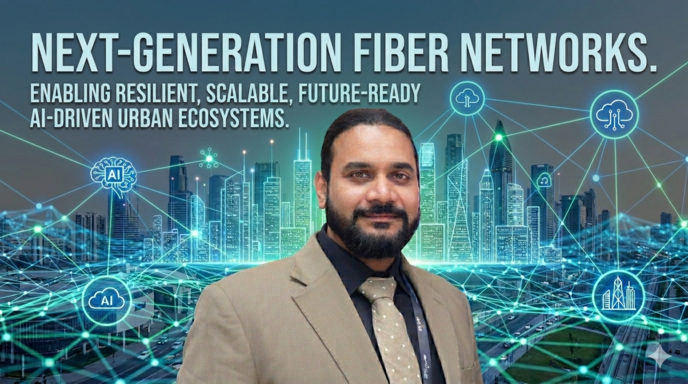
Ata time when most global conversations around artificial intelligence revolve around algorithms, applications, and regulation, Ankit Goel is focused on something far more fundamental—and often overlooked: the physical infrastructure that makes AI possible. As Chairman and Founder of Space World Group, he is building what he calls the “digital backbone” of an AI-ready economy. In this conversation with Smart Governance Editor J P GUPTA, Goel outlines how next-generation fibre networks are becoming the critical enabler of intelligent, connected cities.
On the AI-Ready Backbone: While much of the AI conversation focuses on software, your firm focuses on the “digital backbone.” How are you re-engineering passive infrastructure to meet the massive, low-latency demands of an AI-driven economy?
Artificial intelligence is placing unprecedented demands on digital infrastructure. Unlike traditional applications, which could tolerate some latency and inconsistency, AI workloads require ultra-low latency, high bandwidth, and uninterrupted performance. Optical fibre, in this context, remains the only medium capable of delivering speeds of 100–400 Gbps and beyond while maintaining millisecond-level latency. However, much of the existing fibre infrastructure was built for a different technological era. Ageing networks, designed for legacy applications, are increasingly inadequate for AI-scale workloads. Addressing this gap, Space World Group has developed Constl—a pan-national optical fibre network engineered specifically for AI, hyperscalers, telecommunications providers, and data centres. Rather than retrofitting legacy routes, the network is designed along the shortest and most direct paths between key data hubs, functioning as high-speed digital corridors. Redundancy is built into the architecture, with multiple diverse paths connecting major data centres to eliminate single points of failure. The infrastructure is engineered with deeper fibre deployment, minimal signal loss, and high-capacity scalability embedded from the outset.
Predictive Intelligence & Resilience: You have championed “self-optimising systems.” How are you embedding AI into operations to ensure telecom resilience for critical smart city services?
As networks expand in scale and complexity, operational efficiency becomes as critical as infrastructure itself. The shift is toward intelligent, self-optimising systems where automation and predictive analytics are embedded into network operations. Through technologies such as remote fibre monitoring and integrated operational support systems, networks can detect anomalies in real time, localise faults with precision, and initiate corrective actions automatically. This reduces downtime and enhances service reliability—essential for mission-critical applications. This intelligence extends to the customer layer through platforms like Krypton™, which provide granular, real-time visibility into network performance. Users can monitor connectivity down to individual fibre paths, enabling transparency, control, and on-demand scalability.
On Bridging the Digital Divide: What is your strategy for expanding AI-ready connectivity into emerging cities and ensuring inclusive digital growth?
While early investments in AI-ready infrastructure have focused on major metropolitan hubs, the next phase of growth is expected to be more distributed. Edge computing and decentralised data ecosystems are already driving demand beyond Tier-1 cities. The strategy, therefore, is proactive expansion—extending fibre networks into emerging urban centres ahead of demand. By identifying high-potential locations and integrating them into the broader network architecture, these cities become integral nodes rather than peripheral extensions. The integration of cable landing stations and regional data hubs further supports this distributed model, ensuring seamless connectivity and enabling smaller cities to participate fully in the digital economy.
On Future-Ready Infrastructure: How are you ensuring that today’s infrastructure can support the data and energy demands of 2030 and beyond?
Future-readiness must be embedded at the design stage. As AI-driven workloads grow, infrastructure must scale without requiring disruptive overhauls. This requires a holistic approach—integrating long-haul intercity routes with dense intracity networks.High-capacity fibre corridors, multiple duct systems, and next-generation materials ensure seamless scalability. This allows networks to support a wide range of use cases—from hyperscale data centres to smart buildings and urban edge environments. Recent milestones, including terabit-scale transmission and advanced client interface deployments, illustrate the trajectory of infrastructure evolution. The long-term vision is to build a neutral, pan-national digital backbone that connects cloud platforms, data centres, edge networks, and satellite systems—forming the foundation of an AI-driven future.