By J P GUPTA
The corridors of North Block are unusually restless. Behind closed doors, succession conversations have already begun. Senior bureaucrats are weighing possible extensions, ministries are preparing for reshuffles, and younger officers are sensing the opening of a once-in-a-decade opportunity. In the power architecture of the Indian state, 2026 is no longer being viewed as an ordinary retirement cycle. It is increasingly being seen as a structural reset.
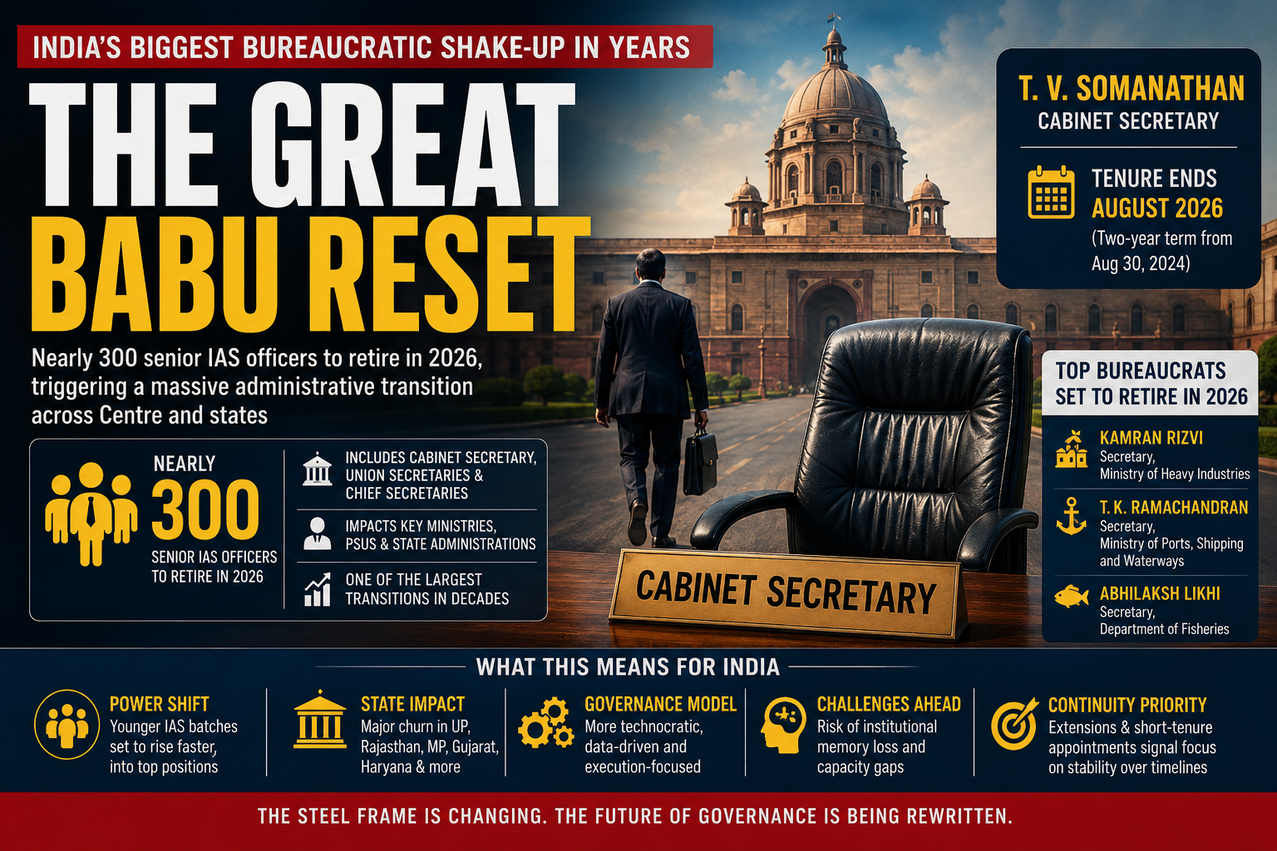
Nearly 300 senior IAS officers are expected to retire during the year. The scale of the exits will impact the Union government, state secretariats, infrastructure ministries, financial administration, and several strategic governance institutions simultaneously. Officials privately describe the coming phase as one of the most consequential administrative transitions in recent memory.
At the centre of the churn stands T. V. Somanathan, India’s Cabinet Secretary, whose fixed two-year tenure concludes in August 2026 unless extended by the government. His scheduled departure has already triggered speculation over who could become the next head of India’s bureaucracy. But the real story stretches far beyond a single office. What is unfolding is a generational transfer of administrative authority across the Indian state.
The Indian Administrative Service functions on carefully calibrated seniority and institutional continuity. When a large cluster of senior officers exits simultaneously, the effects ripple across ministries, departments, and state capitals. This transition is especially sensitive because it affects officers occupying system-critical posts linked to fiscal management, industrial policy, infrastructure delivery, logistics, and Centre-state coordination.
For the Modi government, the timing is significant. India is in the middle of an aggressive infrastructure expansion cycle, rapid digitisation of governance systems, and mission-mode implementation across sectors ranging from semiconductors to logistics corridors. The retirement wave arrives precisely when the Centre is placing unprecedented emphasis on execution, monitoring, and central coordination.
No retirement symbolises the shift more than that of T. V. Somanathan. Widely regarded as one of India’s most intellectually influential bureaucrats, Somanathan brought a technocratic approach to governance that aligned closely with the Centre’s emphasis on fiscal discipline and data-driven administration. Before taking charge as Cabinet Secretary, he served as Finance Secretary, Expenditure Secretary, Additional Secretary in the Prime Minister’s Office, and Managing Director of Chennai Metro Rail.
His tenure became associated with capex-led governance, digital expenditure tracking, procurement reforms, and tighter financial monitoring systems. Within bureaucratic circles, many viewed him as part of a new generation of policy-oriented administrators who combined economic expertise with operational execution.
The eventual appointment of his successor will therefore carry significance beyond personnel management. It will indicate what kind of bureaucracy the Centre wants for the next phase of governance — traditionalist, politically managed, or aggressively technocratic.
The churn, however, is not confined to Delhi.
Across state capitals, the upper layer of administrative leadership is beginning to thin out. Some states are expected to feel the pressure more acutely than others. Uttar Pradesh, which reportedly faces roughly 30 to 34 retirements in the broader transition cycle, could witness one of the sharpest administrative reshuffles. That matters because Uttar Pradesh today sits at the centre of several politically significant infrastructure and welfare programmes, including industrial corridor projects, religious tourism expansion, urban redevelopment, and large-scale public delivery systems.
The retirement cycle is likely to accelerate the rise of younger officers aligned more closely with mission-mode governance and centralised monitoring structures.
In Rajasthan, Chief Secretary V. Srinivas is scheduled to retire in September 2026, although an extension remains possible. Srinivas, a 1989-batch officer who earlier served as Secretary in the Department of Administrative Reforms and Public Grievances, became closely associated with governance modernisation and administrative process reforms after returning from central deputation.
Meanwhile, Madhya Pradesh has already chosen continuity over disruption. Chief Secretary Anurag Jain received a one-year extension keeping him in office until August 31, 2026. The decision reflects a broader administrative trend emerging across India: when investment and infrastructure priorities are considered strategically sensitive, governments increasingly prefer continuity over rigid retirement timelines.
A similar pattern is visible in Haryana, where Chief Secretary Anurag Rastogi received a one-year extension until June 30, 2026. In Gujarat, Chief Secretary Manoj Kumar Das, who took charge in late 2025, is due to retire in December 2026, placing the state back into succession mode within little more than a year of appointing a new administrative chief.
The broader pattern suggests that experienced officers are increasingly being used as transitional anchors while younger batches prepare to move upward into senior governance positions.
The retirement story also underlines the importance of rigorous fact-checking in bureaucratic reporting. Some early transition lists incorrectly included Anu Garg, who took over as Chief Secretary of Odisha in January 2026. Verified reports indicate she still has more than three years of service remaining and is not part of the 2026 retirement cycle. Likewise, AGMUT cadre officer Dharmendra was reported to retire in September 2025 unless extended, not in 2026 as initially suggested.
If anything, those corrections strengthen the larger story. The scale of the transition is dramatic enough even without exaggeration.
Several strategically important ministries are also entering transition mode. Senior officials reportedly due for retirement include Kamran Rizvi in Heavy Industries, T. K. Ramachandran in Ports, Shipping and Waterways, and Abhilaksh Likhi in Fisheries. Their portfolios sit at the heart of India’s manufacturing ambitions, maritime logistics strategy, export competitiveness, and blue-economy expansion.
That concentration of exits has raised concerns inside administrative circles about institutional memory loss. Many of the officers retiring during this phase have decades of experience handling Centre-state negotiations, infrastructure financing, fiscal coordination, and crisis management systems.
To compensate, governments are increasingly relying on selective extensions, short-tenure appointments, and tighter political-bureaucratic coordination. The emerging governance model is becoming more centralised, more technology-driven, and more dependent on measurable execution.
The bureaucracy that emerges after 2026 may look fundamentally different from the traditional IAS order that shaped post-liberalisation India. The Centre increasingly favours officers with expertise in finance, infrastructure execution, digital governance, logistics, AI systems, and data monitoring. The classic “generalist administrator” is steadily giving way to the technocrat bureaucrat.
That transformation may ultimately become the defining legacy of this transition.
When nearly 300 senior officers retire within a compressed period, the consequences extend beyond vacancy creation. Networks weaken. Institutional authority shifts. Younger officers rise faster. The Prime Minister’s Office gains deeper influence over appointments and coordination. Governance styles evolve.
And inside the quiet, heavily guarded corridors of India’s bureaucracy, a new administrative order is already beginning to take shape. The steel frame is changing — perhaps faster than the system itself fully recognises