

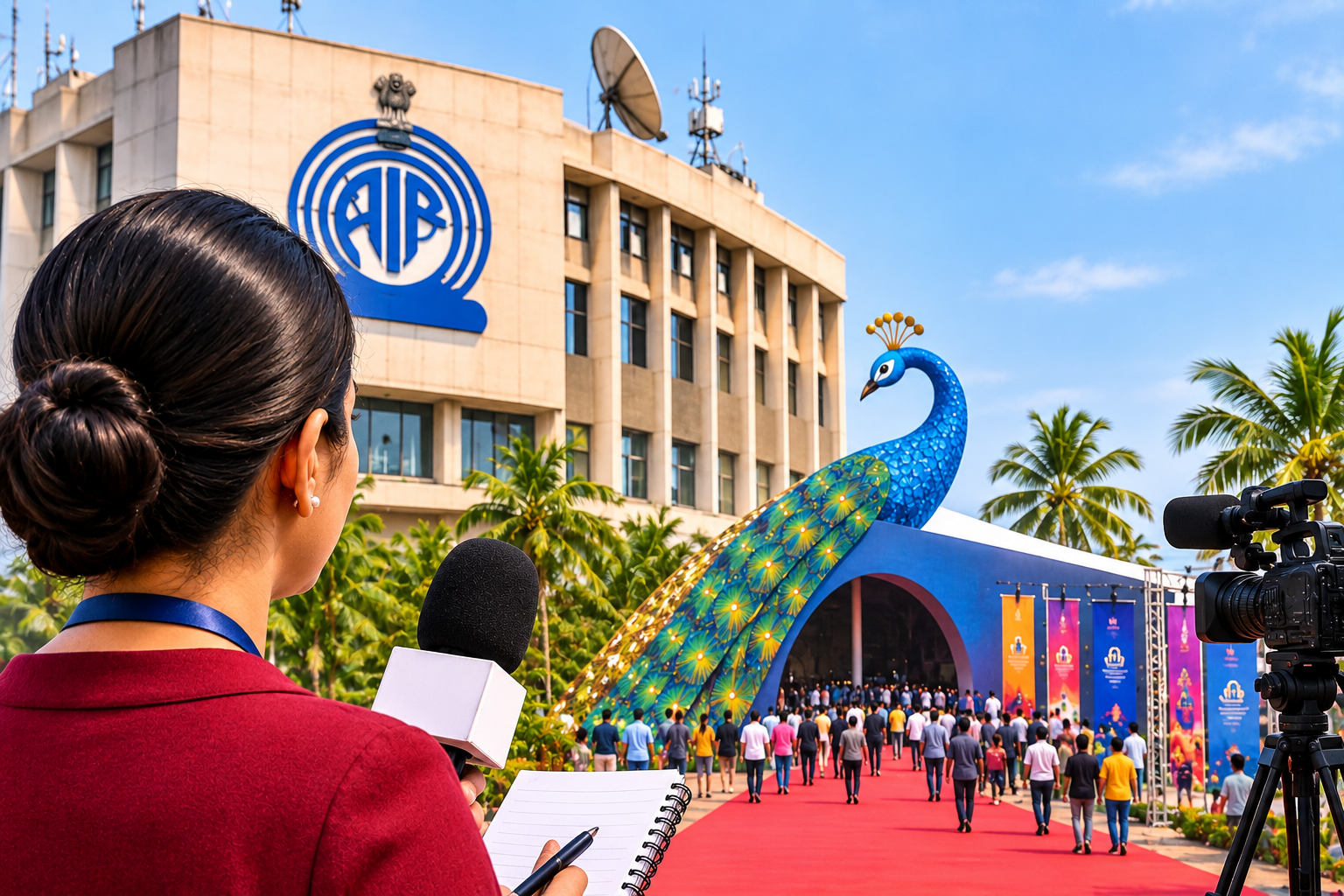
NEW DELHI: All India Radio (Akashvani), which has an established pool of experienced reporters at its headquarters in Delhi and its Goa bureau, is facing questions over its decision to assign a newsreader rather than a dedicated reporter to cover the 57th International Film Festival of India (IFFI 2026).
The reported deployment has raised concerns over editorial judgement, professional priorities and the utilisation of the public broadcaster’s existing reporting resources, particularly as the international film festival prepares to open in Goa on November 20.
What makes the decision more contentious is that Akashvani has reportedly repeated last year’s arrangement by assigning the same newsreader to cover the prestigious international event, despite questions being raised about the quality of her previous coverage.
According to accounts attributed to officials familiar with last year’s coverage, her performance was rated poorly by the AIR news desk and concerned officials. If these assessments are reflected in official records, the decision to repeat the assignment warrants an explanation from the news management.
The question is straightforward: why has Akashvani’s management apparently overlooked its experienced reporting personnel in favour of repeating an assignment that reportedly attracted an unfavourable assessment last year?
The organisation is not short of professional resources. Its Delhi headquarters bureau has reporters with considerable experience in covering national and international events. The Goa bureau, meanwhile, offers the obvious geographical advantage of having personnel familiar with the state and its institutional landscape.
Senior news desk personnel with experience in coordinating and covering major events could also have been considered for the assignment.
Against this backdrop, the decision has brought the role of outgoing Director General of News, Rajiv Jain, into focus. As the official heading the news organisation, Jain’s editorial and administrative decisions concerning deployment of personnel merit scrutiny, particularly when the organisation has experienced reporters available for an event of international significance.
The issue is not about questioning the professional dignity of a newsreader or the importance of his/her role in broadcasting. It is about ensuring that specialised reporting assignments are entrusted to personnel with the appropriate reporting experience and that deployment decisions are guided by professional competence, performance and editorial requirements.
IFFI is not an ordinary local event. The festival brings together filmmakers, delegates, cinema professionals and representatives of the international film industry. Its coverage requires on-the-ground reporting, interviews, interaction with participants, timely dispatches and the ability to identify important developments beyond scheduled events.
A newsreader’s studio responsibilities and the demands of field reporting are not interchangeable. The public broadcaster must ensure that the personnel selected for such assignments are equipped to deliver the depth, accuracy and journalistic quality expected of an international event.
An immediate review is warranted
With the festival scheduled to open on November 20, the Ministry of Information and Broadcasting and the competent authorities in Akashvani need to urgently review the deployment.
The authorities should consider assigning an experienced reporter from either the Delhi headquarters bureau or the Goa bureau, with appropriate editorial support from the news desk. If necessary, the existing assignment should be revised before the festival coverage gets under way.
They should also clarify the criteria used to select personnel for such high-profile assignments and whether last year’s performance assessment was considered before the same individual was reportedly chosen again.
A public broadcaster cannot afford to treat prestigious international assignments as routine personnel postings. Its credibility depends on professional editorial decisions, transparent deployment practices and accountability for the quality of its coverage.
The immediate issue is therefore bigger than one individual’s assignment. It concerns whether Akashvani is making the best use of its journalistic talent and whether its leadership is placing professional reporting standards above administrative convenience.
Before the opening of IFFI 2026, the authorities still have an opportunity to correct the decision. The question is whether they will act in the interest of professional journalism and the credibility of India’s public broadcaster.