India’s semiconductor ambition has moved far beyond the realm of industrial policy. It is now a defining test of governance itself—where the ability of a state to attract, build, and operationalize chip ecosystems has become a proxy for administrative efficiency, foresight, and execution capacity. In this emerging paradigm, silicon is not just powering devices; it is powering governance.
At the heart of this shift lies the India Semiconductor Mission (ISM), backed by a ₹76,000 crore incentive framework designed to catalyze domestic chip manufacturing. What began as a strategic response to global supply chain vulnerabilities has evolved into a nationwide competition among states. From land acquisition and water provisioning to talent pipelines and policy agility, the race to host semiconductor facilities is redefining how governments perform.
The most visible manifestation of this transformation is in Greater Noida, where the Tata Group’s semiconductor fabrication unit has emerged as a cornerstone of Uttar Pradesh’s governance model. Operational since 2025, the facility produces tens of thousands of wafers monthly, feeding into urban infrastructure systems across northern and western India. Locally manufactured chips now underpin Delhi’s intelligent surveillance networks and Gujarat’s real-time water monitoring systems, demonstrating how hardware sovereignty translates into administrative capability.
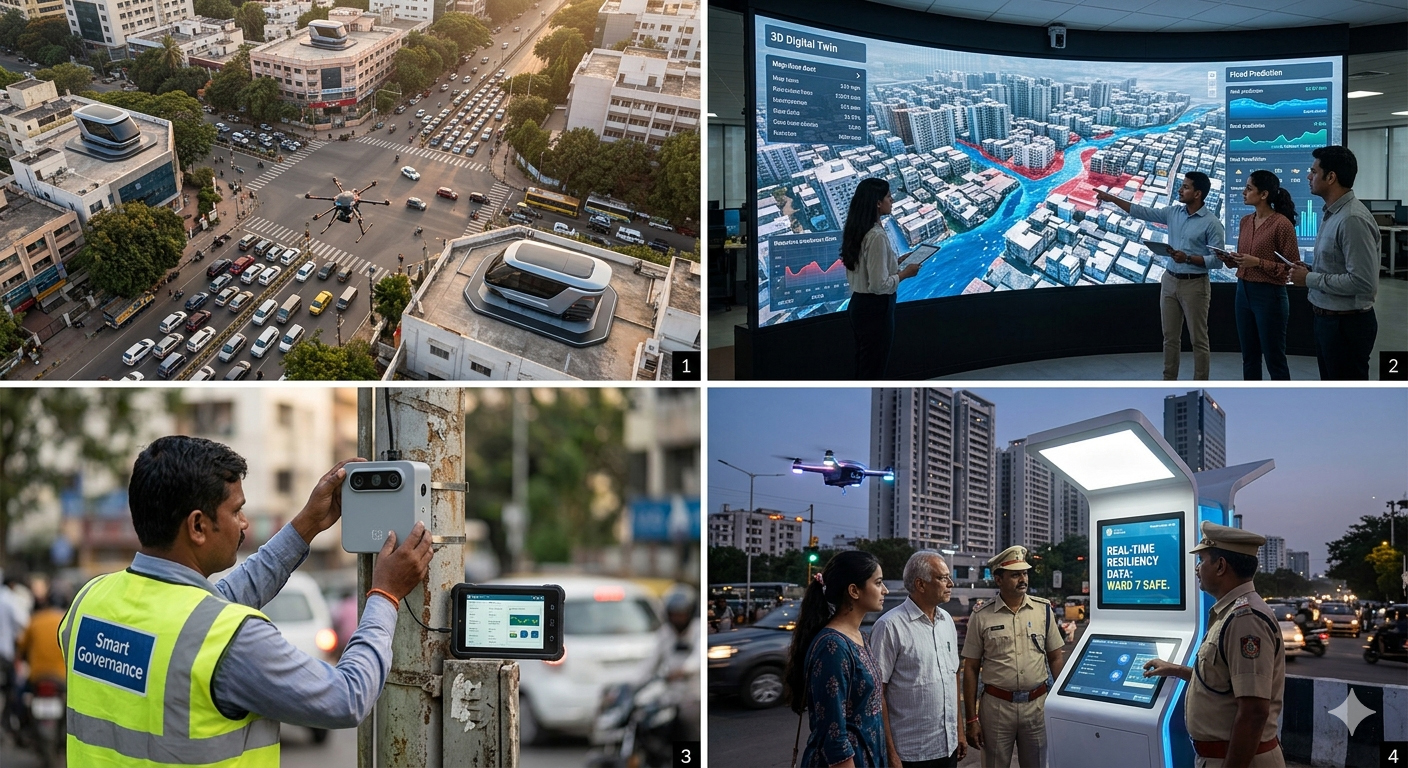
This convergence of policy and silicon is creating what policymakers increasingly refer to as “urban nerve centers.” These are ecosystems where chips power traffic systems, manage utilities, secure public services, and enable predictive governance. The result is not just efficiency, but anticipatory administration—where governments can respond before crises emerge.
Nowhere is this more evident than in Gujarat’s Dholera Special Investment Region (SIR), which has rapidly become India’s semiconductor capital. Anchored by investments from firms like Micron and Tata Electronics, Dholera is not just a manufacturing hub—it is a live laboratory for next-generation governance. Using locally produced chips, the state has deployed a high-fidelity digital twin of the region, allowing authorities to simulate floods, optimize traffic flows, and plan urban expansion with unprecedented precision.
In parallel, the deployment of over a thousand smart kiosks across the region is bringing governance closer to citizens. These kiosks, powered by IoT-enabled chips, provide real-time access to public services, grievance redressal systems, and utility management tools. The result is a governance model that is not only efficient but deeply embedded in everyday life.
Odisha offers another compelling example of how semiconductors are reshaping governance outcomes. In Bhubaneswar, collaborations with Tower Semiconductor have enabled the development of edge AI chips tailored for public service applications. Integrated into the Mo Sarkar platform, these chips allow for on-device data processing, significantly reducing latency and enhancing responsiveness. The impact has been tangible: grievance resolution times have dropped by nearly 40 percent, illustrating how localized hardware can directly improve citizen experience.Karnataka, long known as India’s technology hub, is leveraging semiconductor innovation to enhance urban mobility. In Bengaluru, chips designed within the state are powering predictive maintenance systems for the Namma Metro. By analyzing real-time data from trains and tracks, these systems can anticipate failures before they occur, reducing downtime and improving reliability. This shift from reactive to predictive governance marks a significant evolution in how public infrastructure is managed.
Beyond urban systems, the semiconductor push is also addressing one of governance’s most persistent challenges: leakages in public welfare delivery. In Assam, locally manufactured chips are being integrated into Aadhaar-linked Public Distribution Systems (PDS), adding a hardware layer of security to digital authentication. The result has been a measurable reduction in leakages, with early estimates suggesting a 30 percent improvement in efficiency.
Similarly, in Rajasthan, pilot projects are exploring the use of blockchain-enabled chips for panchayat-level financial tracking. By embedding transaction records directly into hardware, these systems aim to create tamper-proof ledgers for schemes like MGNREGA. This fusion of blockchain and semiconductor technology represents a new frontier in transparency, where accountability is built into the very architecture of governance.
At the national level, strategic collaborations between Bharat Electronics Limited (BEL) and Defence Research and Development Organisation (DRDO) are advancing indigenous semiconductor capabilities in the defense sector. These efforts have already reduced foreign dependence in critical systems such as the Akash missile platform, underscoring the role of semiconductors in national security. Yet, for all its promise, India’s semiconductor journey is not without challenges. One of the most pressing is the projected skill gap. By 2027, the industry is expected to require nearly 400,000 skilled professionals, spanning design, fabrication, testing, and maintenance. Addressing this gap will require a coordinated effort between government, academia, and industry. Encouragingly, international partnerships are beginning to bridge this divide. With over $10 billion in foreign direct investment flowing into the sector, global firms are not only setting up manufacturing units but also investing in training programs. These initiatives aim to equip over 100,000 engineers with the specialized skills needed for semiconductor production, ensuring that India’s talent pipeline keeps pace with its ambitions.
Another critical challenge is resource management, particularly water. Semiconductor fabrication is an extremely water-intensive process, and ensuring sustainable supply will be crucial for long-term viability. States like Gujarat and Tamil Nadu are already exploring innovative solutions, including desalination and water recycling, to address this issue. 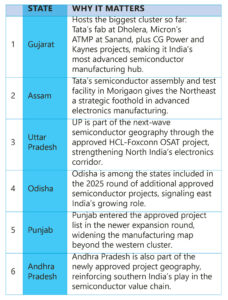
Despite these hurdles, the momentum behind India’s semiconductor mission remains strong. As of early 2026, the country has approved ten major semiconductor projects across six states, with a combined investment exceeding ₹1.60 lakh crore. Gujarat leads the pack, hosting the largest cluster of projects, followed by emerging hubs in Assam, Uttar Pradesh, Odisha, Punjab, and Andhra Pradesh. This geographic diversification is significant. It signals a shift from concentrated industrial development to a more distributed model, where multiple states contribute to—and benefit from—the semiconductor ecosystem. In doing so, it is also fostering a new kind of federal competition, where states are incentivized to innovate, streamline processes, and deliver results.
The economic implications are substantial. Domestic production is already meeting a growing share of India’s semiconductor demand, reducing import dependence and saving billions in foreign exchange. Looking ahead, the government has set an ambitious target of $50 billion in semiconductor exports by 2030, positioning India as a key player in the global chip market.
But perhaps the most profound impact of the semiconductor mission lies in how it is reshaping governance itself. In control rooms across the country, dashboards powered by locally manufactured chips are enabling real-time decision-making. Traffic flows are optimized dynamically, emergency responses are coordinated more effectively, and public services are delivered with greater precision.
In Dholera, for instance, integrated command centers can now predict monsoon patterns and adjust urban systems accordingly. In Bengaluru, metro operations are fine-tuned based on predictive analytics. In Bhubaneswar, citizen grievances are resolved faster than ever before.
These are not isolated successes; they are indicators of a broader transformation.
India’s governance model is becoming increasingly data-driven, decentralized, and responsive—and semiconductors are at the core of this evolution. As states continue to compete and collaborate in equal measure, the “silicon pulse” of governance will only grow stronger.
In this new era, the measure of a state is no longer just its GDP or infrastructure footprint. It is its ability to integrate technology into the fabric of administration, to anticipate challenges, and to deliver outcomes at scale. The semiconductor mission has turned governance into a high-tech contest—and in doing so, it has set the stage for a smarter, more resilient India.
The ISM Policy 2.0 Toolkit
Fiscal Incentives: 50% central subsidies paired with state-level R&D tax breaks for sub-28nm fabrication plants.
Blockchain Tracking: The ISM portal uses blockchain to track subsidy disbursements from the center to the factory floor, ensuring zero slippage.
Silicon Outcomes (Q1 2026)
15% Local Production: Domestic fabs and assembly units now meet a significant portion of India’s chip needs, trimming ₹25,000 crore from import costs.
Target $50 Billion: The ambitious export target for Indian-made semiconductors by 2030, supported by new strategic deals with the EU and Japan.