

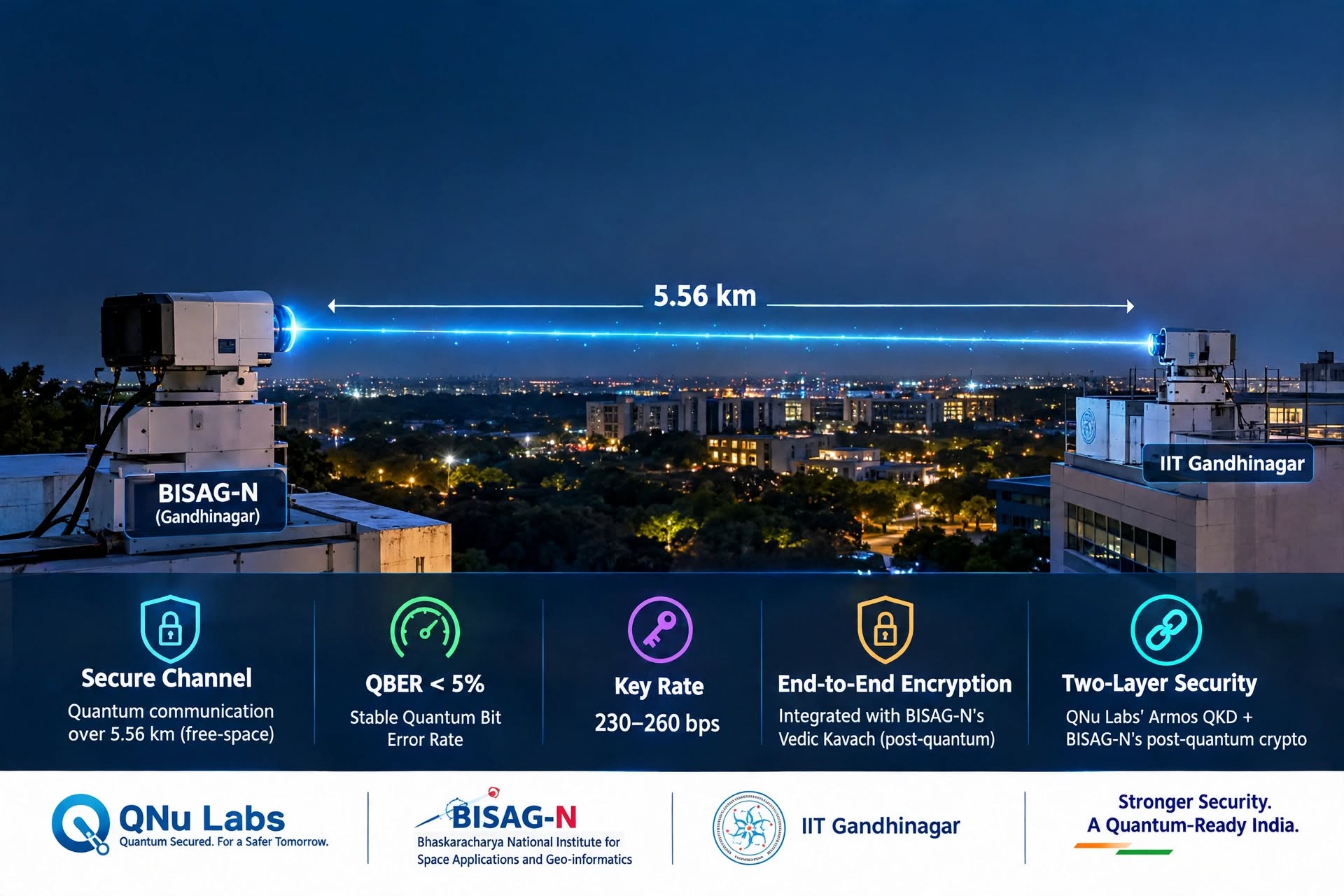
NEW DELHI — India has successfully demonstrated its first free-space Quantum Key Distribution (QKD) link over a distance of 5.56 kilometers, marking a significant step toward secure, quantum-resilient communications, the government said Saturday.
The field trial, conducted on the night of Sept. 27-28 by QNu Labs in collaboration with the Bhaskaracharya National Institute for Space Applications and Geo-informatics (BISAG-N) and IIT Gandhinagar, established a secure quantum communication channel between BISAG-N and IIT Gandhinagar.
The demonstration achieved a stable Quantum Bit Error Rate below 5% and generated secure encryption keys at a rate of 230-260 bits per second, using QNu Labs’ Pointing, Acquisition and Tracking system.
The generated keys were integrated with BISAG-N’s post-quantum cryptography-enabled Vedic Kavach platform, allowing test messages to be encrypted and decrypted successfully from end to end.
The demonstration combined two layers of quantum security. QNu Labs’ Armos QKD device used free-space optical channels to generate and distribute quantum keys, while BISAG-N’s Vedic Kavach provided software-based post-quantum cryptography and quantum random number generation.
The integrated architecture is designed to maintain security even when the physical quantum communication channel is temporarily unavailable.
“This integration marks a significant step toward practical quantum-resilient communication systems,” said Dr. Vinay Thakur, director general of BISAG-N.
Sunil Gupta, co-founder and CEO of QNu Labs, said the 5.56-kilometer demonstration could pave the way for longer-distance quantum-secure networks and satellite-based quantum communications.
Cmde. Manish Tripathi (Retd.), in charge of the Indian Space Technology and Applications Facility at IIT Gandhinagar, said the field trial provided a practical environment for advancing quantum communication technologies and demonstrated the integration of academia, indigenous technology and real-world experimentation.
The trial provides a foundation for strengthening India’s secure communications infrastructure against emerging quantum-era security threats.
BISAG-N, an autonomous scientific society under the Ministry of Electronics and Information Technology, works in space technology applications, satellite communications and geo-informatics and supports technology-driven governance.
IIT Gandhinagar, established in 2008, is an interdisciplinary institution focused on engineering, science, technology, humanities and social sciences.
QNu Labs, founded in 2016, develops quantum-secure digital infrastructure and products, positioning itself as an Indian provider of quantum security technologies.
SEO Keywords