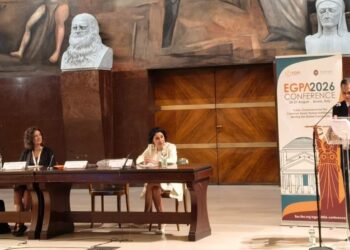


New Delhi: There exists a bargaining power imbalance between digital platforms and business suppliers in digital markets, Competition Commission of India Member Sangeeta Verma opined. She said this while participating in an event.
The flagship Biennial Conference on Competition, Regulation and Development was organised by the CUTS International and CUTS Institute for Regulation and Competition (CIRC) in partnership with OECD, European University Institute (EUI) and Overseas Development Institute (ODI).
However, she opined that “the Indian competition law is broad enough to deal with new-age competition concerns in digital markets”. She also emphasized that the Indian law has extra-territorial jurisdiction and can deal with market practices anywhere in the world if it has anti-competitive effects in India.
This two-day event, held during 16-17 November, was seventh in the series, and the theme this time was Building Blocks for an Inclusive and Resilient Economy.
Moderating Inaugural Session on “Diminishing Multilateralism and Economic Recovery,”Nitin Desai, Former Under-Secretary-General, United Nations, pointed out that “from a political perspective, one of the greatest challenges that liberalism faces is the wide growth of inequality.”
While rejecting protectionism as a tool for economic recovery, Isabelle Durant, Deputy Secretary-General, pointed out how increasing market power is deepening inequality. While market concentration increases the profit of firms, it decreases the wages of employees.
Arancha Gonzalez, former Foreign Minister of Spain and former Executive Director of the International Trade Centre were concerned about the sub-optimal level of international cooperation due to changing geopolitics when the world is dealing with the Covid crisis and economic recovery. “Multilateralism also failed to govern global public goods like health and environment,” she added.
In his address, Rathin Roy, Managing Director (Research and Policy, ODI, opined that national ideation and politics may be one of the crucial barriers to multilateralism. He was also concerned about the dropping of ‘commons’ in the climate change narratives.
Pradeep S Mehta, Secretary General, CUTS International, felt that we should not denounce WTO and multilateralism, but it should be reformed to engender more inclusivity.
_____