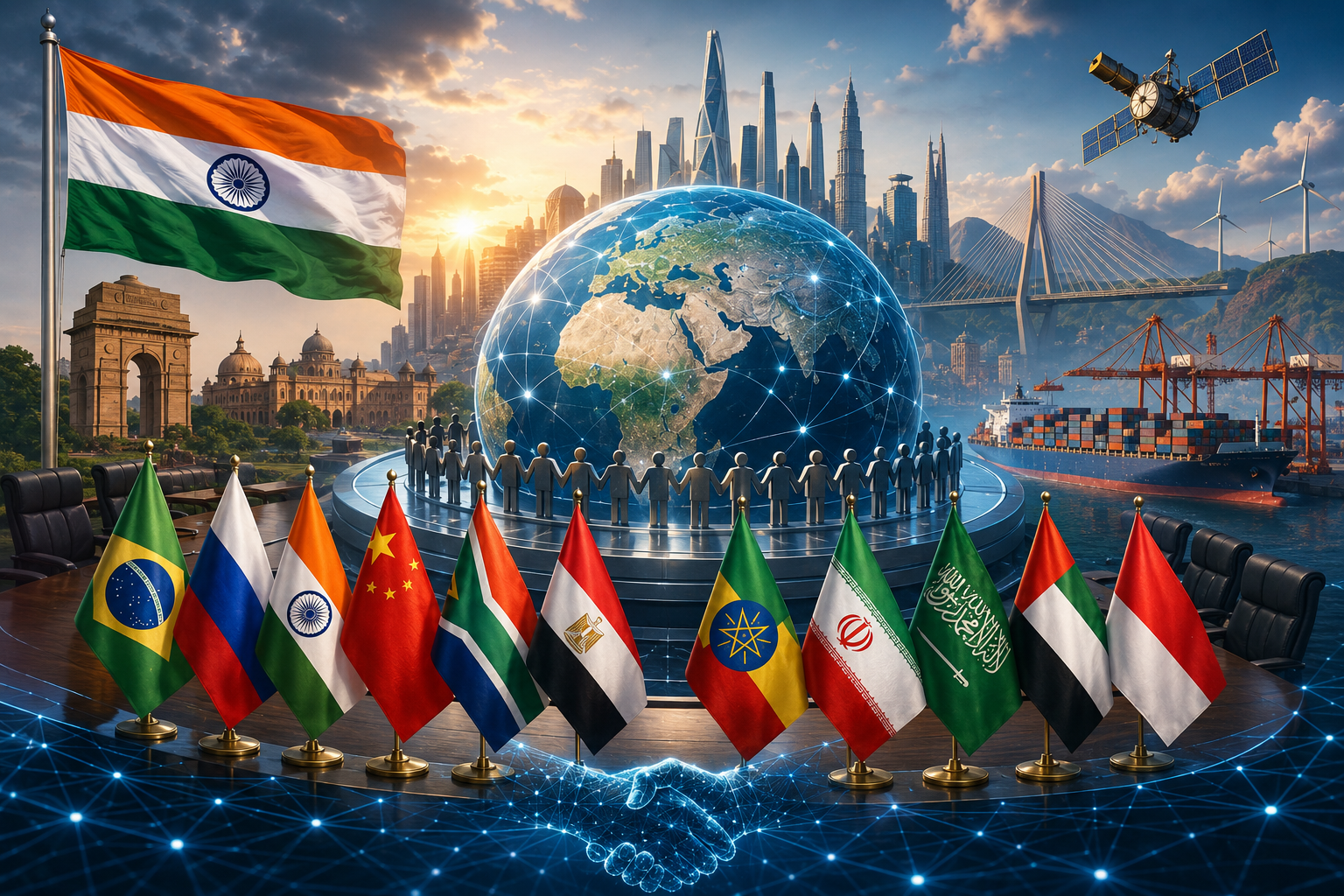

NEW DELHI — As India assumes the 2026 BRICS chairship under the banner “Building for Resilience, Innovation, Cooperation, and Sustainability,” the global geopolitical landscape is undergoing a non-linear transformation. The tenure marks a threshold for a bloc that has metastasized from a compact alliance of five emerging economies into an expansive 21-nation matrix featuring 11 full member states and 10 official partner countries.
The core grouping now integrates Brazil, Russia, India, China, South Africa, Egypt, Ethiopia, Iran, Saudi Arabia, the United Arab Emirates and Indonesia. Surrounding this core is a newly formalized perimeter of partner states spanning Belarus, Bolivia, Cuba, Kazakhstan, Malaysia, Nigeria, Thailand, Uganda, Uzbekistan and Vietnam. Together, they represent a dominant share of the Global South’s demographic weight, economic output and energy reserves.
Yet, operating on strict internal consensus, the sprawling “BRICS+” configuration introduces profound analytical complexities for New Delhi as it prepares to host the 18th Leaders’ Summit. Rather than attempting to forge an impossible political monolith across regional rivalries, India is steering the bloc toward practical, project-driven alignments.
The Pune Blueprint: Tech Sovereignty in Action
A primary indicator of this functional shift emerged from the 7th BRICS Information and Communication Technologies (ICT) Working Group meeting in Pune. Centered on India’s capabilities in Digital Public Infrastructure (DPI), delegates deliberated a concept note for a centralized BRICS DPI Repository and launched cross-border pilot projects to ensure global software interoperability.
“Digital public infrastructure is not just technology. It is sovereignty in the digital age—the ability to govern your own data, your own transactions, your own citizens’ digital lives,” said an Indian official involved in the Pune deliberations.
Beyond evaluating advances in artificial intelligence, next-generation telecom, and Industry 4.0, the Digital BRICS Task Force initiated terms of reference for specialized bodies on digital applications and governance. Proposals for a joint BRICS submarine cable network further signal a collective push toward intra-bloc infrastructure autonomy, deliberately structured to decrease reliance on Western-controlled telecommunications corridors.
Balancing Functional Alignment with Geopolitical Friction
The collaborative momentum in the digital sphere highlights how technical cooperation often outpaces geopolitical consensus within the expanded bloc. While external Western analysts frequently critique BRICS as a “coalition of the dissatisfied” bound by opposition rather than a shared vision, the Pune blueprint demonstrates that functional construction and opposition can coexist without requiring strict ideological alignment.
For New Delhi, maintaining this balance is a delicate diplomatic exercise. India maintains robust strategic, technological, and economic ties with Western capitals and active participation in plurilateral frameworks like the Quad.
Addressing this dynamic, Indian External Affairs Minister S. Jaishankar has noted: “If BRICS becomes an anti-Western grouping, it will fail. The moment it is seen as a vehicle against any particular country, its developmental agenda is compromised”.
India’s overarching strategy focuses on promoting institutional reform, multipolarity and equity for the Global South without allowing the platform to devolve into an anti-Western instrument.
Local Currencies and Financial Interoperability
Central to the expanded framework is the creation of financial mechanisms that insulate member states from macroeconomic vulnerabilities and unilateral sanctions. The ongoing discourse around de-dollarization centers on expanding local-currency trade settlements to cut transaction costs and bypass third-party clearing systems.
However, New Development Bank officials emphasize that these efforts are not designed as an ideological assault on the U.S. dollar, but rather as a pragmatic alternative to mitigate systemic volatility and sanctions risk.
Given the significant trade imbalances within the 21-nation grouping—particularly China’s dominant manufacturing exports—the immediate trajectory favors national digital currency interoperability and localized clearing systems over a single alternative currency. This approach allows participating nations to maintain monetary sovereignty while building economic resilience against external shocks.
Ultimately, India’s 2026 chairship illustrates a shift in contemporary multilateralism toward flexible, issue-specific arrangements. By focusing on concrete, modular projects—such as shared digital repositories, independent data governance standards, and diversified financial clearing—New Delhi is positioning BRICS to operate as a pragmatically pluralist force in a fragmenting global order.