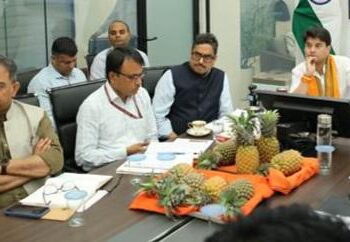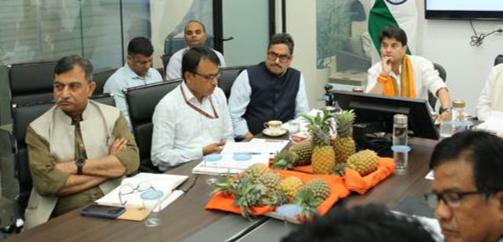
AGARTALA: India’s Ministry for Development of North Eastern Region (MDoNER) has launched “Mission Queen Pineapple,” a 2.36 billion rupee ($28.4 million) initiative aimed at transforming Tripura’s signature fruit into a globally competitive brand.
Union Minister Jyotiraditya M. Scindia, alongside Tripura Chief Minister Manik Saha, unveiled the three-year roadmap designed to run from the second quarter of fiscal year 2026 through the fourth quarter of fiscal year 2028. The multi-ministry convergence program aims to upgrade the state’s pineapple cultivation into an integrated, export-ready value chain.
“Under Prime Minister Narendra Modi’s vision, Tripura’s agricultural strengths are being transformed into globally competitive brands,” Scindia said during the launch event, which drew virtual attendance from farmers, food processors, and agricultural investors. “Our goal is to build a complete value chain—from farm to global markets—so that farmers become active participants in the prosperity created by their produce.”
Tripura’s Queen Pineapple holds a Geographical Indication (GI) tag—a legal protection certifying its unique geographic origin and distinct qualities, including a low-fiber texture and high sweetness. Despite these premium traits, MDoNER Secretary Sanjay Jaju noted that local smallholder growers currently receive only 6 to 10 rupees (approximately 7 to 12 cents) per kilogram at the farmgate due to systemic infrastructure bottlenecks and weak market integration.
To bridge this valuation gap, the mission will deploy a “Hub and Spoke” logistics network. A primary post-harvest hub will be built near Agartala airport, feeding into eight regional collection centers across major cultivation clusters in West Tripura, Khowai, and Sepahijala. The infrastructure plan includes advanced grading facilities, solar-powered cold storage, reefer transport networks, and Internet of Things (IoT)-enabled farm monitoring with digital QR-code traceability systems.
The initiative also plans to revive the idle Nalkata Pineapple Processing Unit via a Viability Gap Funding model managed by the North Eastern Regional Agricultural Marketing Corporation (NERAMAC) alongside private sector partners.
Emphasizing a bio-economy strategy, Scindia explained that the mission will target the 60% of the pineapple plant that is traditionally discarded as agricultural waste. The program will establish commercial facilities for bromelain extraction (an enzyme used in medicine and food), pineapple leaf fiber textile processing, and GI-branded confectionery manufacturing. Officials estimate these circular-economy initiatives will open up major employment opportunities for indigenous tribal communities and women’s self-help groups.
Chief Minister Saha emphasized that the fruit, which is grown naturally without chemical inputs in Tripura’s hilly terrain, holds massive potential. “The state government is heavily promoting value addition, packaging, and direct market linkages to double farmers’ incomes and generate long-term rural employment,” Saha said.
The implementation framework will also introduce organic certification support, international buyer-seller meets, and structured GI monetization workshops. To boost public marketing, the state will host an annual “Tripura Queen Pineapple Festival” aligned with International Pineapple Day on June 27.