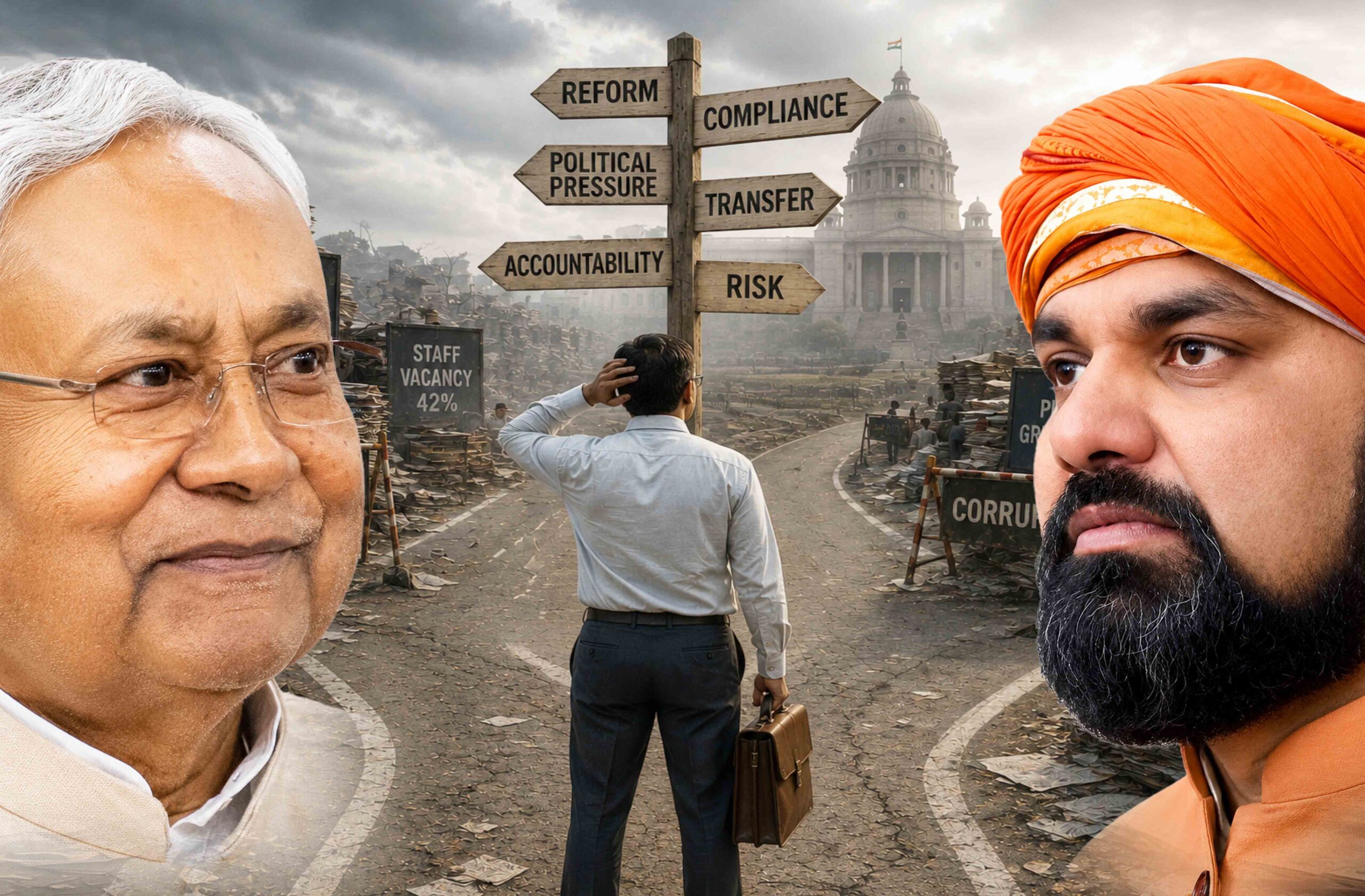
For nearly two decades, Bihar’s dominant political vocabulary revolved around a single, powerful expression — Sushasan, or good governance. Under the long stewardship of Nitish Kumar, the state witnessed an undeniable administrative revival. Roads pierced through neglected hinterlands, electrification reached forgotten villages, school infrastructure expanded, and the spectre of lawlessness that once haunted Bihar appeared to recede.
What emerged during those years was not merely a developmental narrative, but a carefully cultivated image of Bihar as a model of bureaucratic resurgence — a state attempting to rewrite its history through administrative discipline and political stability.
Yet, history has a habit of exhausting its own slogans.
Today, beneath the glow of digital dashboards, online portals, performance reviews and carefully choreographed governance campaigns, Bihar’s administrative machinery appears burdened by fatigue. The once-assertive bureaucracy now often seems hesitant, over-centralised, and deeply risk-averse. Public confidence in institutions has weakened, while service delivery increasingly struggles under the weight of procedural stagnation and institutional caution. Into this atmosphere steps Samrat Choudhary, heading Bihar’s first BJP-majority government. He inherits a state apparatus that remains vast in structure but uneven in efficiency — a bureaucracy accustomed to continuity,
wary of disruption, and shaped by decades of political calibration.
The challenge before him is therefore larger than administrative reform. It is fundamentally about institutional renewal. The pressing question is no longer whether Bihar requires reform; that reality is self-evident. The real uncertainty is whether the existing system still possesses the capacity to transform itself from within.
A SYSTEM UNDER STRESS
The structural weaknesses within Bihar’s administrative framework are no longer anecdotal; they are measurable. Vacancy levels, unstable postings, and persistent pendency reveal a governance apparatus struggling to maintain efficiency at scale.
A particularly alarming concern is the severe shortage of senior administrative leadership. Nearly two-fifths of sanctioned IAS positions remain vacant, forcing several officers to manage multiple departments simultaneously. This dilution of leadership inevitably weakens strategic execution and policy continuity.
Equally damaging is Bihar’s culture of rapid transfers. District Magistrates and key field officers are frequently shifted before they can establish administrative continuity or institutional accountability. Such instability discourages long-term planning and strengthens local patronage networks.
When officers remain uncertain about the longevity of their postings, administrative courage becomes a liability rather than an asset. Confronting entrenched local interests or exposing corruption begins to carry professional risks with little institutional protection.
The result is a bureaucracy increasingly inclined toward procedural survival rather than decisive governance.
LAND: THE EPICENTRE OF GOVERNANCE FAILURE
No issue captures Bihar’s administrative crisis more sharply than land governance.
Across the state, disputes relating to mutation delays, fraudulent registries, boundary conflicts, and encroachments continue to dominate grievance systems. Land remains both an economic resource and a political instrument — and the dysfunction surrounding it has generated deep social distrust.
At the centre of this crisis lie Circle Offices, which in many districts have evolved into opaque administrative power centres. Here, clerical intermediaries, local political actors, and informal agents often operate within entrenched patronage systems that manipulate records, delay approvals, and convert basic services into opportunities for rent extraction.
The consequences extend far beyond rural disputes. Bihar’s inability to establish reliable land records has significantly damaged investor confidence. Industrial expansion, logistics projects, and infrastructure investments continue to face delays because land ownership verification remains uncertain and litigation-prone.
For investors, unpredictability is more damaging than scarcity. And Bihar’s land administration continues to project unpredictability at scale.
THE ILLUSION OF DIGITAL GOVERNANCE
Over the past decade, Bihar aggressively promoted digital governance initiatives — online certificates, RTPS services, grievance portals, digitised land records, and public dashboards.
On paper, these reforms suggested administrative modernisation. In practice, however, many citizens continue to encounter a familiar reality: acknowledgement without resolution.
Complaints are registered online, reference numbers are generated instantly, and automated responses create the appearance of efficiency. Yet, meaningful action frequently remains absent. Citizens often describe grievance systems as digital waiting rooms rather than instruments of accountability.
This has produced what governance analysts increasingly describe as an “illusion of responsiveness” — where technology improves visibility but fails to enforce responsibility.
Digital governance, in Bihar’s case, has often succeeded in documenting dysfunction rather than correcting it.
THE B.R.A.P. FRAMEWORK: A POSSIBLE ROADMAP
If Bihar seeks genuine administrative renewal, reform must move beyond slogans and adopt structural clarity. A workable framework may rest upon four interconnected pillars — Bureaucracy, Responsiveness, Accountability, and Performance.
- Rebuilding a “Doer” Bureaucracy
Administrative continuity is essential. Minimum fixed tenures for District Magistrates and Superintendents of Police would restore stability and reduce arbitrary transfers.
Equally important is a shift in evaluation culture. Promotions and recognition must increasingly reward measurable outcomes rather than seniority alone. Districts demonstrating innovation in service delivery should become governance laboratories for wider replication.
- Restoring Responsiveness
Citizen interaction with the state cannot remain transactional and indifferent. Every grievance submitted through digital platforms should receive time-bound acknowledgement and resolution tracking.
Automated escalation systems could ensure that unresolved cases move upward through administrative layers instead of disappearing into departmental silence.
- Declaring War on Land Corruption
Land administration requires technological and legal overhaul simultaneously. A statewide cadastral resurvey, integration of police and revenue databases, and tamper-resistant digital record systems are urgently needed.
More critically, deliberate administrative delay in mutation and registry processes must attract enforceable penalties. Without consequences, reform mechanisms eventually lose credibility.
- Introducing a Bihar Performance Index
District-level governance indicators should be made public through quarterly performance scorecards. Metrics relating to school attendance, health services, crime response, RTPS compliance, and industrial clearances can create competitive accountability within the bureaucracy itself.
Fiscal incentives for high-performing districts — alongside administrative audits for consistently poor performers — may gradually encourage a culture of measurable governance.
THE DEEPER CRISIS
Bihar’s governance crisis is not merely institutional; it is sociological.
Administrative functioning continues to be shaped by three enduring forces: caste-driven influence over postings, political patronage networks, and bureaucratic self-preservation. Together, these forces create an ecosystem where transparency becomes difficult and reform becomes politically expensive.
This is why successive governance experiments often produce only cosmetic change. Digital systems may evolve, official language may modernise, but the deeper operational culture remains largely untouched.
Unless the present regime demonstrates both political will and institutional consistency, Bihar risks repeating a familiar cycle — reform announcements followed by administrative inertia.
THE MORAL QUESTION OF GOVERNANCE
At its core, Bihar’s governance challenge is ultimately moral as much as administrative.
A system survives not merely through laws or technology, but through public trust. When citizens begin to assume that delays are inevitable, corruption unavoidable, and accountability negotiable, institutional legitimacy slowly erodes.
The state then drifts toward what many analysts describe as an “economy of compliance” — where silence ensures survival and initiative invites vulnerability.
Reversing this trend requires more than dashboards, reviews, or disciplinary notices. Bihar needs an administrative ethic that values integrity over patronage, delivery over symbolism, and public service over procedural ritual.
From the era of Sushasan to the rise of Samrat Choudhary, Bihar now stands at a defining political and administrative juncture. The coming years will determine whether this transition becomes a genuine reinvention of governance — or merely a change of political vocabulary atop an unchanged bureaucratic culture.
For Bihar’s 13 crore citizens, the stakes are immense. Roads, bridges, and power grids can be constructed with funding and policy. But responsive governance demands something rarer: institutional courage.
Bihar’s Bureaucratic Stress Test
| Indicator | Bihar (2026) | India Average | Source |
| IAS Sanctioned Strength | 359 | — | DoPT 2026 data |
| IAS in Position | ~208 | — | DoPT 2026 |
| IAS Vacancy (%) | ~42% | ~22% (National) | DoPT 2026 |
| DM Average Tenure | 9–10 months | 18–24 months | 2nd ARC State Studies |
| File Pendency (avg dept.) | 18–27% | 9–12% | CAG–Bihar 2024 |
| Public Grievance Acknowledgement (online) | <40% within deadline | — | DARPG e-Governance Survey 2025 |
| Mutation Case Pendency | 12 lakh+ | — | Bihar Revenue Dept., March 2026 |
THE EROSION OF ADMINISTRATIVE AUTHORITY
The Bihar bureaucracy of the early 200s carried a distinct sense of force and certainty. Officers associated with that era often projected the image of a state reclaiming authority after years of political turbulence. Figures such as the late K.P. Ramaiah symbolised interventionist governance, while officers like K.K. Pathak became synonymous with uncompromising administrative enforcement. Whether admired or feared, they represented a bureaucracy willing to act decisively. That confidence, however, has steadily diminished.
Today’s bureaucracy appears increasingly managerial rather than transformational. Files continue to circulate, reviews are regularly conducted, and digital systems generate constant streams of administrative data — yet the gap between process and outcome remains glaring. Governance has become heavily procedural, but less impactful.
Many observers attribute this shift to the gradual centralisation that marked the later phase of Nitish Kumar’s tenure. Decision-making increasingly revolved around a narrow and trusted administrative circle, creating a culture where caution overshadowed initiative. Over time, obedience became safer than innovation. This produced a bureaucratic ecosystem deeply conditioned to hierarchy and continuity. With the political transition now underway, that system finds itself exposed — uncertain of new power equations, resistant to abrupt change, and reluctant to abandon familiar patterns of functioning.
THE CULTURE OF SILENCE
Perhaps the most corrosive feature of Bihar’s bureaucracy today is not corruption or inefficiency alone, but institutional fear.
Within administrative circles, particularly at middle and lower levels, a silent doctrine governs behaviour: avoid attention, avoid confrontation, avoid risk.
This culture of cautious invisibility has gradually replaced the earlier ethos of assertive administration. Officers prefer procedural compliance over bold decision-making because the system often punishes initiative more quickly than failure.
Such an environment weakens governance in subtle but devastating ways. Delays become routine, responsibility becomes diffused, and innovation disappears beneath layers of caution.
Bihar’s developmental challenge, therefore, is not merely financial. It is administrative psychology. The state increasingly suffers from a paralysis of execution — a condition where decisions are endlessly processed but rarely implemented with urgency.
SAMRAT CHOUDHARY’S MOMENT OF TEST
Samrat Choudhary’s rise carries considerable symbolic significance. For the first time in decades, Bihar is witnessing a BJP-led government operating without the balancing compulsions of coalition dependence on JD(U).
This transition has naturally generated expectations of a sharper administrative style — one focused on accountability, technological efficiency, and measurable delivery.
The new Chief Minister has already signalled impatience with bureaucratic lethargy. His early public statements suggest a willingness to confront delays and tighten performance monitoring. Yet rhetoric alone cannot transform a deeply layered administrative culture.
The obstacles before him remain formidable. Senior officials shaped by the previous political order continue to dominate institutional structures. Patronage systems remain deeply woven into district-level administration. Fiscal pressures constrain ambitious reform, while political realities often complicate strict enforcement.
The true test of Samrat Choudhary’s leadership will therefore lie not in announcing reform, but in institutionalising it without destabilising governance itself.