By JP Gupta
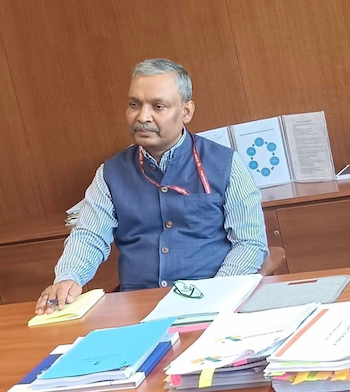
New Delhi : When a seasoned bureaucrat ,1992-batch Bihar cadre IAS officer Chanchal Kumar took over as the Secretary of the Ministry of Information and Broadcasting this week, the file notes on his desk already carried the baggage of ambition, turf battles, and a decaying communication machinery. Behind the official jargon and protocol‑bound briefings lies a parallel ecosystem—one of entrenched bureaucratic clans, parochial networks, and a flagship publication accused of being more political marketing tool than public‑messaging bridge.
Observers say the new secretary is not just inheriting a policy brief; he is stepping into what insiders describe as “a carefully guarded fiefdom” built over years by a section of senior IIS (Indian Information Service) officials who have made the ministry’s flagship outreach vehicle, New India Samachar (NIS), their own turf of power and influence.
Many who have worked in the I&B Ministry stress that Chanchal Kumar faces a layered challenge: external geopolitical complexity, internal bureaucratic inertia, and a deeply politicized information‑dissemination apparatus that has repeatedly failed to project a coherent narrative on critical issues, including the ongoing West Asia conflict. The outgoing setup, they say, did not merely miss the messaging boat; it squandered the opportunity to shape how India’s position reached the masses, leaving the public field to a collage of unrelated bulletins rather than a structured policy‑line.
A Ministry of Narratives That Never Quite Formed
The I&B Secretary is formally the government’s top communicator, tasked with weaving a consistent narrative across TV, radio, print, and digital platforms on everything from domestic policy to foreign crises. In recent years, the ministry’s effort has been stretched particularly thin over the West Asia situation, where New Delhi’s calibrated but often ambiguous posture—balancing ties with Arab states, Israel, and India’s large diaspora—demanded crisp, coordinated messaging. Yet, as government insiders and former officials concede, the ministry failed to deliver.
Last year, as the West Asia situation intensified, the Press Information Bureau (PIB) reportedly set up what was internally called a “war room” to coordinate reporting and messaging on the conflict. In practice, however, this effort was reduced largely to a mechanical compilation of news bulletins from All India Radio (Akashvani) and Doordarshan News, without any overarching guidance or a clearly articulated government line. There was no “talking points” document, no centralized messaging matrix, and no cross‑departmental coordination to ensure that the I&B machinery amplified the government’s position rather than just relayed the news.
“The so‑called war room was more of a news‑cutting‑and‑paste operation,” said a senior PIB official on condition of anonymity. “There was no narrative design. Ministries threw their statements into the media ecosystem, and the I&B Ministry did not step in to consolidate and frame them for the public.”
This lack of a central, authoritative narrative prompted whispers within the policy circle that the I&B Secretary could not, or would not, rise to the occasion as a “chief communicator.” Some argue that the limited role of the I&B Ministry in the West Asia communication architecture left the government vulnerable to partisan or fragmentary interpretations in the media and on social platforms. In such a climate, the responsibility for framing the story drifted to partisan TV channels, social‑media influencers, and competing official spokespersons rather than a single, coordinated message from the Centre.
The Rise and the Rot of New India Samachar
At the heart of this narrative deficit lies New India Samachar, the multilingual fortnightly publication whose longevity belies a controversial lineage and a questionable value for money. NIS was launched in 2020 as a fortnightly, and expanded into Hindi, English, and several regional languages. Conceived as a “people’s magazine” to disseminate the government’s achievements and policy messages, it has instead become emblematic of opaque staffing, lavish expenditure, and a quiet takeover by a network of IIS officers and supporting officials.
An internal financial audit and cross‑departmental scrutiny over the years reportedly flagged excessive printing costs, an over‑staffed editorial setup, and a pattern of selective recruitment influenced by the then‑Union Minister Prakash Javadekar. The publication is produced by the Central Bureau of Communication (CBC), an attached office of PIB, which spends lakhs of rupees every month on printing, freight, and distribution for a readership that remains difficult to quantify. Despite its mammoth circulation on paper, New India Samachar has little visible digital footprint. It has no dedicated social‑media team, negligible engagement on major platforms, and no clear strategy to convert its print gravitas into public‑policy narrative in the online age.
Critics argue that in an era where governments worldwide use targeted digital campaigns to shape opinion, NIS remains a “white elephant”—a print‑only, resource‑heavy project that fails to reach the majority of Indians who now consume information via mobile phones, YouTube, and short‑form video. “It’s a throwback to a pre‑smartphone era,” said a former IIS officer involved in media planning. “The government spends crores on a publication that has no real digital strategy. Narratives are not built in stapled booklets; they’re built in shareable, searchable, and measurable digital content.”
Beyond the resource argument, the more serious concern is about editorial capture. Several former and current officials say that the magazine’s editorial functions are not driven by a coherent policy or communication vision, but by the interests of a small group of IIS officers and their allies within PIB and CBC.
Inside the IIS “Caucus”
Any new I&B Secretary quickly learns that the ministry’s real levers of power lie less in the Secretary’s office and more in the middle‑layer network of IIS officers who control the flow of communication—from press releases and advisories to media sensitization camps and narrative shaping. Veteran watchers describe this network as a “caucus” that activates whenever a fresh Secretary joins and attempts to chart an independent course. The pattern is often the same: initial resistance, followed by a quiet re‑orientation of the Secretary into the existing ecosystem.
Apurva Chandra, who served as I&B Secretary till recently, is cited as a partial exception. A senior civil servant with a reputation for cautious but firm control, Chandra is said to have tried—at least in the early phase of his tenure—to keep IIS officials at arm’s length, seeking to depoliticize communication and rely more on data‑driven narratives. However, according to insiders, even his efforts were diluted by the layered influence of the IIS caucus, which has deep roots in the PIB, Doordarshan, and CBC, and controls access to the senior echelons of the ministry.
The caucus’s influence is most visible in the staffing and functioning of New India Samachar. The magazine’s editorial structure, it is alleged, is dominated by multiple consulting roles or short‑term contracts. Over the years, the publication has also become a favored destination for lateral entrants and loyalists, leading to accusations of “selective recruitment” and an atmosphere of insulation rather than independent journalism.
Nexus and Narrative Control: The Secretary’s Secretariat Under Siege
The pressure is not only structural but also operational. Insiders say that the IIS‑linked network has effectively extended its reach into the Secretary’s Secretariat, where routine file management can become a subtle instrument of power. According to several officials, certain “sensitive” files or emails that might threaten the interests of influential officials are quietly filtered out, their contents never reaching the Secretary’s desk. In extreme cases, the claim is that such files are “killed” in the system or delayed indefinitely, shielding the network from scrutiny.
“Files are not just processed; they are curated before they reach the Secretary,” said a mid‑level officer in the I&B Ministry who requested anonymity. “There is a sense that some people in the system manage the information flow so that uncomfortable questions simply don’t surface at the top.”
Adding to the friction is the magazine’s troubled human‑resources record. A serious internal storm erupted in 2024 when a Language Editor of New India Samachar filed a complaint of sexual harassment against a couple of contractual editors having good relation with some senior officials. The complaint, which allegedly identified patterns of abuse and intimidation, was handled by the ministry’s Internal Complaints Committee (ICC). However, according to sources privy to the proceedings, the matter was effectively quashed instead of being allowed to run its full course.
The handling of the case reveals a disturbing confluence of power and complicity. As per the accounts of officials who spoke off the record, the IIS “mafia” within the ministry—labelled by insiders as a closed network of IIS officers and their allies—actively worked to isolate the complainant. The network reportedly included senior figures such as the then‑Additional Director General (ADG) in the Prime Minister’s Media Unit, Dheeraj Singh, and an IIS‑cadre Joint Secretary in the I&B Ministry, Senthil Rajan, who are said to have coordinated moves to push the editor out of the publication. The then‑Principal Director General of PIB, Dhirendra Ojha, and the ICC chairperson, Pragya Paliwal, are also said to have played a role in diluting the complaint, ultimately allowing it to recede without a visible institutional response.
To fortify the system against future challenges, a curious move was made in September 2024: a departmental notification was issued stating that only editors under the age of 55 would be eligible for appointment as consulting editors in the publication. On the surface, this may appear to be a routine age‑based reform.
In practice, it effectively bars many experienced, senior editors and consultants—often those who might be temperamentally or professionally inclined to question the status quo—from joining or remaining in key roles. In the government ecosystem, consultants are usually mid‑career or senior professionals above 50 or 55; the age bar is interpreted by critics as a thinly‑veiled move to keep dissenting, experienced voices out of the editorial structure.
“On paper it looks like a benign age‑norm; on the ground it’s a shield,” said a legal expert familiar with the case. “The ministry, through a seemingly technical rule, has created a firewall against independent or critical engagement in the magazine’s content.”
Chanchal Kumar’s Challenge: Rebuilding a Broken Narrative Machine
For Chanchal Kumar, the task is threefold. First, he must rebuild the government’s communication architecture—ensuring that the I&B Ministry is not just a relay hub for media copy but the central node of a strategic narrative, especially during crises like the West Asia conflict. This means setting up a real “war room” with a mandate to coordinate inter‑ministerial communication, design message frameworks, and track public perception. Without this, the ministry will continue to be reactive rather than proactive.
Second, he must address the dead weight of New India Samachar*. The magazine cannot be allowed to remain a costly, print‑centric relic with political and bureaucratic baggage. The new Secretary has an opportunity to restructure the publication around a clear editorial vision: a small, professional, and independent editorial team, a robust digital strategy with a dedicated social‑media unit, and a transparent content policy that prioritizes public policy narratives over partisan glorification.
This will require:
-
Bringing in editors and consultants of ideas and grit, unconstrained by age‑based technicalities or political loyalty.
-
Merging or reorienting NIS’s print and digital strands so that the same message is amplified across platforms in a measurable way.
-
Instituting a transparent, merit‑based recruitment and editorial‑oversight framework, with strict conflict‑of‑interest rules and a firewall between political influence and content.
Third, and perhaps most difficult, is the bureaucratic overhaul. The IIS caucus and its network may resist any attempt to dilute their influence, particularly in PIB, CBC, and the publication’s editorial board. However, a Secretary who can align with the Prime Minister’s Office (PMO) and the Cabinet Secretariat on a clear “narrative reform” agenda has room to push back. The appointment of senior, non‑IIS media professionals, the strengthening of the digital‑communication wing, and the insulation of the ICC and personnel‑management systems from undue influence will be essential.
The controversy surrounding the sexual‑harassment case is not just a footnote; it is a stark indicator of the human cost of institutional rot. When a formal complaint is quietly buried, and the complainant is pushed out instead of being protected, it not only violates the safety and dignity of the individual but also erodes trust in the institution itself. For a ministry that claims to speak on behalf of the people, this is a profound contradiction.
If New India Samachar is to reclaim even a fraction of its original purpose—to inform, educate, and engage the public—then the culture that produced and shielded the 2024 episode must be dismantled. This will require a clear message from the Secretary: that editorial independence is non‑negotiable, that complaints will be treated transparently, and that the interests of the audience, not of a narrow bureaucratic‑political nexus, will guide content.
The challenges Chanchal Kumar faces are emblematic of a larger problem in India’s public communication system: a disconnect between the vast, modern information ecosystem that ordinary Indians inhabit and the slow, politicized, and often opaque machinery that the government uses to speak to them. The West Asia episode was a reminder that the government can be diplomatically agile while its communication machinery remains stuck in the last decade.
New India Samachar stands at the intersection of this contradiction—a symbol of both ambition and failure. The magazine has the budget, the reach, and the brand name to be a powerful tool for public‑policy communication. Yet, due to mismanagement, political capture, and a self‑serving network, it has become, in many ways, the I&B Ministry’s albatross.
How the new Secretary chooses to handle it will be a key test of his leadership. Will he treat New India Samachar as a cherished project of the establishment, to be quietly protected and preserved? Or will he recast it as a lean, digital‑first, editorial‑independent narrative engine that can actually help the government talk to the people, not just at them?
In the age of the smartphone and the algorithm, this is not just a question of revamped media strategy. It is a question of institutional integrity.