By Krishan Gopal Sharma
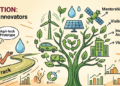
There is something irresistibly futuristic about a train that runs on hydrogen. No diesel smoke. No overhead wires. No familiar locomotive rumble. Just a train gliding through the landscape, with water vapour as its direct by-product.
For a country that wants to be seen as both technologically ambitious and environmentally responsible, the image is almost too perfect. India’s first indigenous hydrogen-powered train, flagged off in July 2026 on the Jind-Sonipat section in Haryana, carries that symbolism with it. The 10-coach train has two hydrogen-powered driving cars, a combined power output of 2,400 kW and space for around 2,600 passengers. A dedicated hydrogen storage and refuelling facility has also come up at Jind.
It is a serious engineering achievement, and it deserves recognition as one. But technology has a way of becoming more impressive in photographs than it is in spreadsheets. And that is where the hydrogen train story becomes far more interesting. The real question is not whether a hydrogen train can run. Clearly, it can. The question is whether hydrogen is the smartest way to move trains in the places where India actually needs it.
Hydrogen has a clear case on routes where conventional electrification is difficult or prohibitively expensive. A fuel-cell train can avoid the need for continuous overhead infrastructure while offering an alternative to diesel. That makes the technology potentially useful for remote, regional and heritage routes.
But India is not approaching the problem with a railway network still dominated by diesel. It has already spent years changing that picture. According to the Ministry of Railways, 99.6% of the broad-gauge network is now electrified, while new line and multi-tracking projects are also being sanctioned and built with electrification.
That statistic changes the debate. Where overhead electricity is already available, why take electricity, turn it into hydrogen, compress and store the hydrogen, carry it to the train, convert it back into electricity through a fuel cell and accept the losses at every stage? Hydrogen is not a source of free energy. It is an energy carrier. Where the wires are already in place, the detour is difficult to ignore.The case becomes stronger only where those wires do not make economic or practical sense. That distinction should sit at the centre of India’s hydrogen-rail strategy.
The economics still need to be proved
This is the part of the conversation that needs some restraint. When Indian Railways announced the Hydrogen for Heritage initiative in 2023, it envisaged 35 hydrogen trains at an estimated cost of about ₹80 crore each, apart from investment in associated ground infrastructure. The Railway Ministry also acknowledged that the running cost of such trains in India had yet to be established and that initial costs were expected to be higher.
That admission matters. It means the economic case was not a settled proposition. It was a proposition to be tested.
There is nothing wrong with that. Every major technology needs pilots. Costs can fall as manufacturing expands. Supply chains improve. Components become cheaper. Skills develop. A technology that looks expensive at the beginning can become competitive later.
But that is precisely why a pilot should be treated as a pilot. It is an experiment, not a verdict.
There is also a tendency to assume that avoiding overhead wires means avoiding infrastructure costs. It does not. The Jind project includes dedicated hydrogen storage, compression and dispensing facilities, with storage capacity of nearly 3,000 kg. The infrastructure has not disappeared. It has simply moved from the sky above the track to the ground beside it.
Germany offers a useful warning
India is not the first country to discover the promise of hydrogen rail, and it is not the first to discover the complications either.
Germany’s Coradia iLint became a pioneering hydrogen passenger train and demonstrated that fuel-cell propulsion could work on a non-electrified regional route. That was an important milestone. But the German experience also raised a harder question: what does it cost compared with the alternatives?
A study commissioned by the state of Baden-Württemberg found hydrogen trains substantially more expensive over their lifecycle than battery-electric alternatives on the routes examined, with the difference estimated at up to 80% over 30 years.
The lesson was not that hydrogen trains could never work. It was that the right technology depends on the route, the infrastructure and the economics. A train can be technologically successful and still not be the best solution.
Quebec offers another perspective. Alstom’s hydrogen train demonstration there carried more than 10,000 passengers over 130 trips in 2023. It showed that hydrogen propulsion could operate on a non-electrified scenic railway and avoid the direct emissions associated with diesel. But it was also a publicly supported demonstration project.
That is perfectly normal. Governments routinely support emerging technologies because society has something to gain from learning what works and what does not. The mistake would be to confuse proof of concept with proof of commercial superiority.
The train may be only part of the story
There is another, more strategic way to look at India’s hydrogen-train experiment. Perhaps the train itself is not the destination. Perhaps it is an early customer in a much bigger industrial project.
India’s National Green Hydrogen Mission aims to develop a domestic hydrogen ecosystem, including a target of 5 million tonnes of annual green hydrogen production by 2030. The government sees major potential in sectors such as refining, fertilisers, steel and shipping, where direct electrification can be difficult.
A hydrogen train brings together many of the capabilities such an ecosystem needs: hydrogen production, storage, compression, refuelling, safety systems, fuel cells, batteries, maintenance and trained manpower. Railways can therefore do more than consume hydrogen. They can help create a market for it.
There is a sound industrial-policy argument in that. Emerging technologies need demand before they can achieve scale; scale encourages manufacturing, manufacturing encourages competition, and competition can eventually bring prices down.
But that policy objective should be stated plainly. The public can understand an industrial experiment. What deserves scrutiny is the habit of presenting every experiment as though it were already an economic triumph.
Where hydrogen could make sense
None of this means hydrogen trains have no future in India. They may have a useful and quite specific one.
On non-electrified routes where overhead electrification would be disproportionately expensive, environmentally intrusive, or technically difficult, hydrogen could be a sensible option. Heritage railways are an obvious case, which is why the Hydrogen for Heritage programme has included routes such as Kalka-Shimla.
The government’s own description of the Jind-Sonipat train is telling. Its purpose is to demonstrate operational viability, safety, and reliability under regular operating conditions. That is a perfectly reasonable objective.
It is also a much more measured claim than saying hydrogen is about to transform Indian Railways. For now, the technology may be best served by that modesty.
Green does not automatically mean economical
One more question often disappears when green technology is discussed: the cleanest-looking machine is not necessarily the greenest or the most economical one over its entire life.
The full energy chain matters. Where is the hydrogen coming from? How much renewable electricity is needed to produce it? How much energy is lost in production, compression, storage, and conversion? What does the ground infrastructure cost? How long will the equipment last? What happens to fuel-cell stacks and batteries at the end of their useful lives? And what does one passenger-kilometer actually cost compared with direct electric or battery-powered traction?
These are not anti-hydrogen questions. They are pro-evidence questions.
India has already achieved something far larger than the launch of a single hydrogen train: it has built an enormous electric railway platform, with 99.6% of the broad-gauge network electrified. The challenge now is to ensure that the next generation of green technology complements that achievement rather than quietly duplicating it at a higher cost.
India’s first hydrogen train deserves neither blind applause nor instant dismissal. It deserves measurement.
Let it run. Measure its fuel consumption. Publish the cost per kilometer. Compare it honestly with diesel, battery, and conventional electric alternatives. Calculate the full lifecycle cost. Measure the renewable electricity required to make the hydrogen. Track reliability and maintenance. Then decide where the technology belongs.
If hydrogen proves competitive on particular routes, use it. If batteries work better elsewhere, use batteries. If direct electrification remains the most efficient answer, there is no embarrassment in sticking with it. That is what sensible technology policy looks like. The objective is not to collect the largest number of futuristic machines. It is to deploy the right machine, on the right route, at the right cost. India has already moved much of its railway system away from diesel and towards electric traction. The next phase should not be driven by the excitement of novelty alone. Hydrogen may well earn a place on India’s tracks. But it should earn that place through evidence, not receive it simply because it carries the green label.
- The hydrogen train is an impressive piece of engineering, and there is no reason to diminish that achievement. The concern is different. Whenever a new technology arrives wrapped in the language of transformation, public discussion can move faster than the evidence—particularly when public money is involved.
-
Hydrogen may eventually become an important part of India’s clean-energy story. The larger hydrogen ecosystem may even prove more consequential than the trains themselves.
-
Good public policy does not require every experiment to succeed. It requires the country to learn honestly from the experiment.
-
Perhaps that is the real test of a green revolution: not how futuristic the train looks, but whether we are willing to ask what it costs, what it saves, and where it genuinely belongs
-
The writer is a retired officer of the Indian Information Service and a freelance writer. He has also worked as an international media consultant with UNICEF Nigeria and contributes regularly to various publications. Author: kgsharma1@gmail.com.