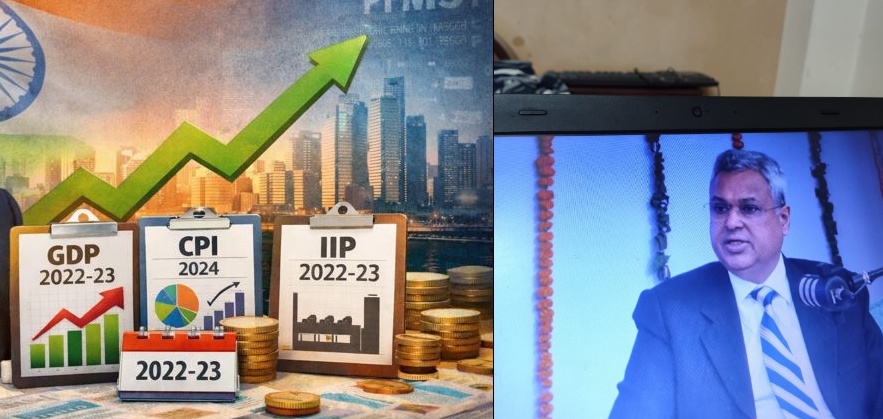
NEW DELHI (SG) — India is set to rebase key macroeconomic indicators — Gross Domestic Product (GDP), Consumer Price Index (CPI) and the Index of Industrial Production (IIP) — to better reflect structural changes in the economy following the COVID-19 pandemic, Ministry of Statistics and Programme Implementation (MoSPI) Secretary Dr. Saurabh Garg said.
Speaking in a podcast with public broadcaster Akashvani, Garg said the current base year of 2011–12 no longer captures the realities of India’s rapidly evolving economy, marked by digitization, changing consumption patterns, growth in renewable energy and the availability of new administrative data sources such as the Goods and Services Tax (GST) and the Public Financial Management System (PFMS).
“Base years are like fixed goalposts against which economic performance is measured,” Garg said. “When the structure of the economy changes significantly, those goalposts must be shifted to ensure accurate measurement of growth and inflation.”
India has chosen 2022–23 as the new base year for GDP and IIP, a move Garg said was deliberate to avoid distortions caused by the pandemic-hit years of 2019–20 and 2020–21. The year 2022–23 marked the first broadly “normal” post-COVID period and is backed by fresh household consumption surveys and updated production data.
The rebasing exercise will also bring India’s statistical systems in line with evolving international methodologies and standards recommended by the United Nations Statistical Commission, Garg said.
MoSPI has laid out a tight timeline for the release of revised data. The new CPI series, with a revised base year of 2024, is scheduled to be released on Feb. 12, 2026. Revised GDP estimates based on 2022–23 are expected by the end of February 2026, while the updated IIP series will follow in May 2026.
The revised CPI will expand its consumption basket to about 400 items, up from the current 350, reflecting shifts in household spending. Field staff will collect price data from around 2,500 markets each month, generating millions of data points nationwide.
Garg underlined the real-world impact of these indicators on policymaking and everyday life. CPI inflation data plays a critical role in the Reserve Bank of India’s monetary policy decisions, including setting the repo rate, which influences borrowing and deposit rates. GDP and IIP data shape assessments of industrial activity, employment trends and investment flows.
He noted that India’s statistical system is among the fastest globally, with CPI data released within 12 days of the reference month, aided by the use of anonymized industry data and digital workflows.
MoSPI is also expanding public access to official data through digital platforms such as the e-Sankhyiki portal, which allows AI-enabled queries, and the GOI Stats mobile application.
“Data for Development is our guiding principle,” Garg said, emphasizing that timely, reliable and accessible statistics are essential for evidence-based policymaking and smart governance in a fast-changing economy.