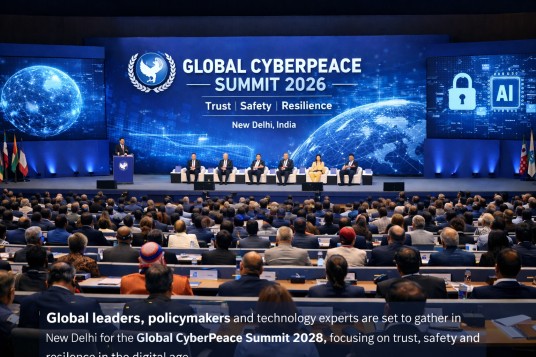
NEW DELHI: The Global CyberPeace Summit 2026, scheduled from February 8 to 10 in New Delhi, will convene one of the world’s largest multi-stakeholder platforms focused on Trust & Safety, CyberPeace and digital resilience, organisers said on Wednesday.
The summit will bring together governments, parliamentarians, law enforcement agencies, defence and diplomatic leadership, technology companies, academia, civil society and everyday internet users to address emerging challenges shaping the global digital ecosystem.
The announcement was made at a curtain-raiser event addressed by Major Vineet Kumar, Founder and Global President of CyberPeace; S.N. Pradhan, IPS (Retd.), Global CEO and Chief Mentor; and M.A.K.P. Singh, Chief Technical Officer, CyberPeace. Speakers said the summit aims to move global cyber discussions from intent to measurable, actionable outcomes.
“Trust in the digital ecosystem can no longer be taken for granted. It has to be consciously built, measured and protected,” Major Kumar said, calling the summit a step toward collective global action.
The first two days of the event, to be held at the United Services Institution of India, will focus on capacity building, including hackathons, cyber awareness programmes, first-responder training, and digital skilling initiatives in collaboration with global technology partners.
The flagship summit day on February 10 at Bharat Mandapam will host over 1,000 participants, featuring a Trust & Safety plenary, Netizen Townhall, and parallel sessions on cybercrime coordination, cyber diplomacy, defence security, critical infrastructure protection, AI governance and quantum security.
The summit will also see the launch of major global initiatives, including an AI scholarship programme aimed at building role-ready skills for safe AI adoption, and the Global Quantum Threat Alliance, focused on preparing governments and institutions for emerging quantum-era security risks.
Organisers said the Global CyberPeace Summit 2026 reinforces the idea that cyberspace trust and safety are not just policy or technology issues, but people-centric global challenges requiring coordinated action.