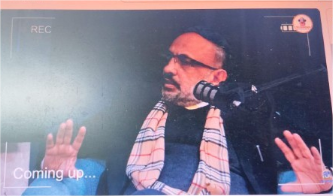
India’s vision of becoming a Viksit Bharat by 2047 is not just a slogan—it is a fundamental shift in how the nation thinks about growth, governance, and global standing. In an exclusive Akashwani podcast, Rajiv Gauba, former Cabinet Secretary of India and currently Member of NITI Aayog, explains why this ambition marks a decisive break from the past.
Earlier development goals focused on eliminating poverty or improving select sectors. That changed on August 15, 2022, when Prime Minister Narendra Modi articulated the idea of a fully developed India by the centenary of Independence. Since then, the idea has cascaded through ministries, states, think tanks, businesses, and universities—each preparing their own roadmaps to 2047.
“Viksit Bharat represents a massive leap in national ambition. It moves us from incremental change to transformational outcomes.”
— Rajiv Gauba
PRAGATI: Turning Vision into Execution
Ambition without execution, Gauba argues, means little. This is where PRAGATI (Pro-Active Governance and Timely Implementation) becomes the backbone of India’s governance transformation.
India has always undertaken large infrastructure projects—highways, railways, ports, power corridors. What stalled them were bottlenecks: land acquisition, forest clearances, inter-departmental delays. PRAGATI was designed to cut through these obstacles using a single digital platform.
All projects worth over ₹500 crore are listed on the PRAGATI portal. Every month, the Prime Minister personally reviews 25–30 projects, with state Chief Secretaries and senior central officials present—ensuring instant decisions and real-time accountability.
“PRAGATI is not a review meeting. It is a problem-solving platform where issues are resolved on the spot.”
Cooperative Federalism, Live and Real
What makes PRAGATI unique is how it reshapes Centre–State relations. Gauba calls it a live demonstration of cooperative federalism, something he says he had never witnessed at this scale during his decades in public service.
By bringing all stakeholders onto a single platform, governance silos collapse. Officials see the full picture—across ministries, states, and timelines.
Recalling his tenure as Chief Secretary of Jharkhand, Gauba notes how PRAGATI allowed state governments to track all major projects in one place and push rapid resolutions.
“When everyone is on one screen, silos disappear. That is the real power of cooperative federalism.”
₹85 Lakh Crore and Counting
The scale of PRAGATI’s impact is unprecedented. Projects worth over ₹85 lakh crore have moved forward under its monitoring.
According to Gauba, technology plays a critical role—but so does psychology. Since officials never know which project will be reviewed each month, preparedness becomes a system-wide habit.
Iconic projects like the Chenab Rail Bridge, the world’s highest railway arch bridge, and strategic infrastructure in the Northeast saw major acceleration through this mechanism.
“Continuous monitoring at the highest level creates momentum across the entire government machinery.”
Human Capital: The Real Foundation of Viksit Bharat
Infrastructure alone cannot define a developed nation. Gauba emphasizes that human capital lies at the heart of the 2047 vision.
The PM-SHRI schools initiative reflects this focus. With 14,500 centrally funded schools, the programme aims to create model institutions showcasing modern infrastructure, digital learning, and holistic education. The larger goal is replication—encouraging states to raise standards across all schools.
“Human capital is the bedrock of Viksit Bharat. Everything else flows from it.”
Manufacturing: From Import Dependence to Export Power
India’s manufacturing turnaround offers one of the clearest proofs of policy-led transformation. Gauba points to mobile phone manufacturing as a standout success.
In 2014, nearly 78% of mobile phones were imported. Today, imports are below 1%, and India is the world’s third-largest exporter of mobile phones.
“Mobile manufacturing shows what happens when policy, scale, and execution come together.”
Defense: Breaking a Self-Imposed Barrier
The defense sector, long dependent on imports, has undergone a similar shift. Gauba describes earlier restrictions—limiting production largely to the public sector—as a self-imposed handicap.
Reforms opening defense manufacturing to private players and startups, supported by platforms like iDEX, have transformed India into a growing defense manufacturer and exporter.
“Opening defense production to innovation and startups has completely changed the landscape.”
A National Mission, Not a Government Scheme
As India marches toward 2047, Gauba is clear that Viksit Bharat cannot be achieved by government alone. It must become a people’s movement.
He reveals that even AI tools were used to analyze suggestions from students across India, capturing how young citizens imagine a developed nation.
“The Prime Minister didn’t just articulate a vision—he created the foundation for the whole country to move together.”
The Road to 2047
The journey to Viksit Bharat is no longer abstract. It is being built through dashboards, deadlines, classrooms, factories, and bridges. With PRAGATI as its execution engine, India’s development story is becoming faster, more accountable, and more collaborative—one project at a time.
Watch the full insight here: https://www.youtube.com/watch?v=gSE29IXH0vU