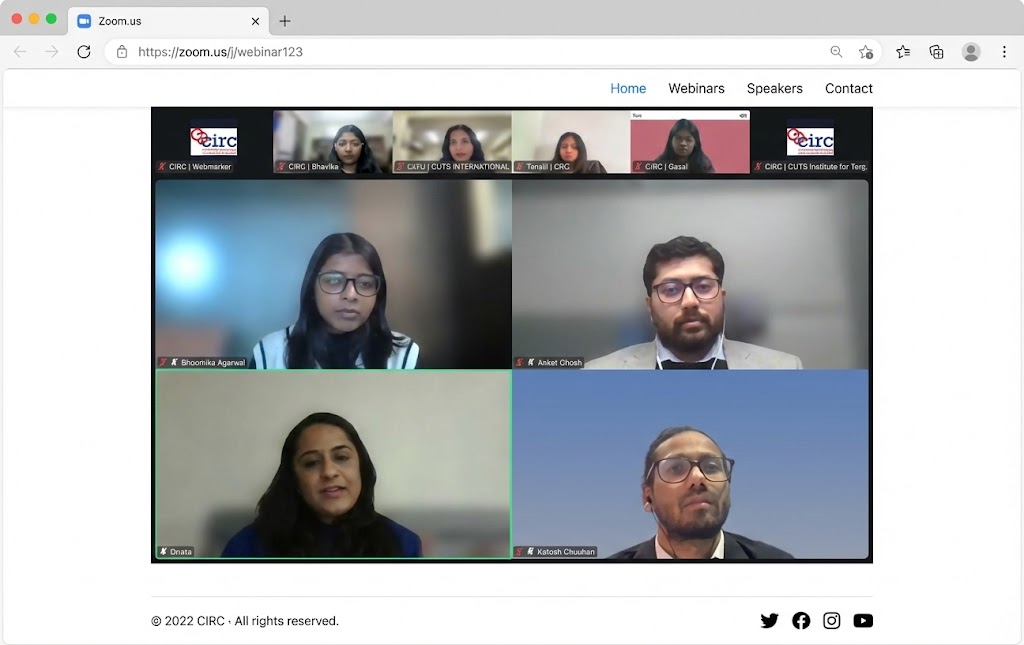
New Delhi — Legal and policy experts have called for stronger regulatory scrutiny of digital platforms, warning that rapid advances in artificial intelligence, rising market concentration and the spread of “dark patterns” are reshaping competition in ways existing frameworks may struggle to address.
The concerns were raised during a virtual webinar, “Platform Competition & Regulation: Navigating Innovation, Market Power and Dark Patterns,” hosted by the CUTS Institute for Regulation & Competition (CIRC) in collaboration with law firm King Stubb & Kasiva (KSK). The session drew more than 40 participants, including lawyers, researchers and policy professionals.
Aniket Ghosh, partner at KSK, said competition authorities are increasingly shifting focus from corporate intent to system design and market outcomes, particularly in cases involving algorithmic conduct.
“The CCI’s evolving approach reflects a shift from intent to design and outcomes—scrutinising whether AI-enabled systems incorporate self-imposed checks, with emphasis on the tool’s objective, underlying data, and observable market effects,” Ghosh said, responding to a question on algorithmic collusion.
On data as a source of dominance, Ghosh cautioned against treating it as inherently decisive. “While data is often seen as a source of market power, its value depends on how effectively it is combined with product quality and innovation. Data becomes an asset only when complemented by innovation,” he said.
Kailash Chauhan, chairperson of the AI Development Committee at the Indian Society of Artificial Intelligence and Law (ISAIL), argued that voluntary compliance models may be inadequate in data-heavy markets.
“In data-intensive markets, reliance on self-regulation should give way to heightened regulatory scrutiny,” Chauhan said, adding that understanding India’s digital economy requires deeper interdisciplinary research spanning law, economics and technology.
Questioning the effectiveness of self-regulation proposed in the Competition Commission of India’s AI Market Study, Drishti Parnami, fellow at CIRC, said enforceability remains a key concern.
“While self-regulation is often presented as a workable solution, the real question is whether big tech will meaningfully self-regulate without enforceable standards and data-driven oversight,” she said, warning that unchecked algorithmic pricing could evolve into “a new-age form of predatory pricing.”
Moderating the discussion, Bhoomika Agarwal, program manager at The Dialogue, highlighted the regulatory challenge posed by increasingly sophisticated digital manipulation.
“As digital manipulation grows more sophisticated, regulators must invest in AI-enabled tools and technological capacity to identify dark patterns, backed by consistent advocacy and skill-building initiatives,” Agarwal said.
CIRC is a research and capacity-building organisation focused on competition, regulation and economics. KSK is a full-service Indian law firm with offices in eight cities, advising on competition law, technology regulation and corporate matters.