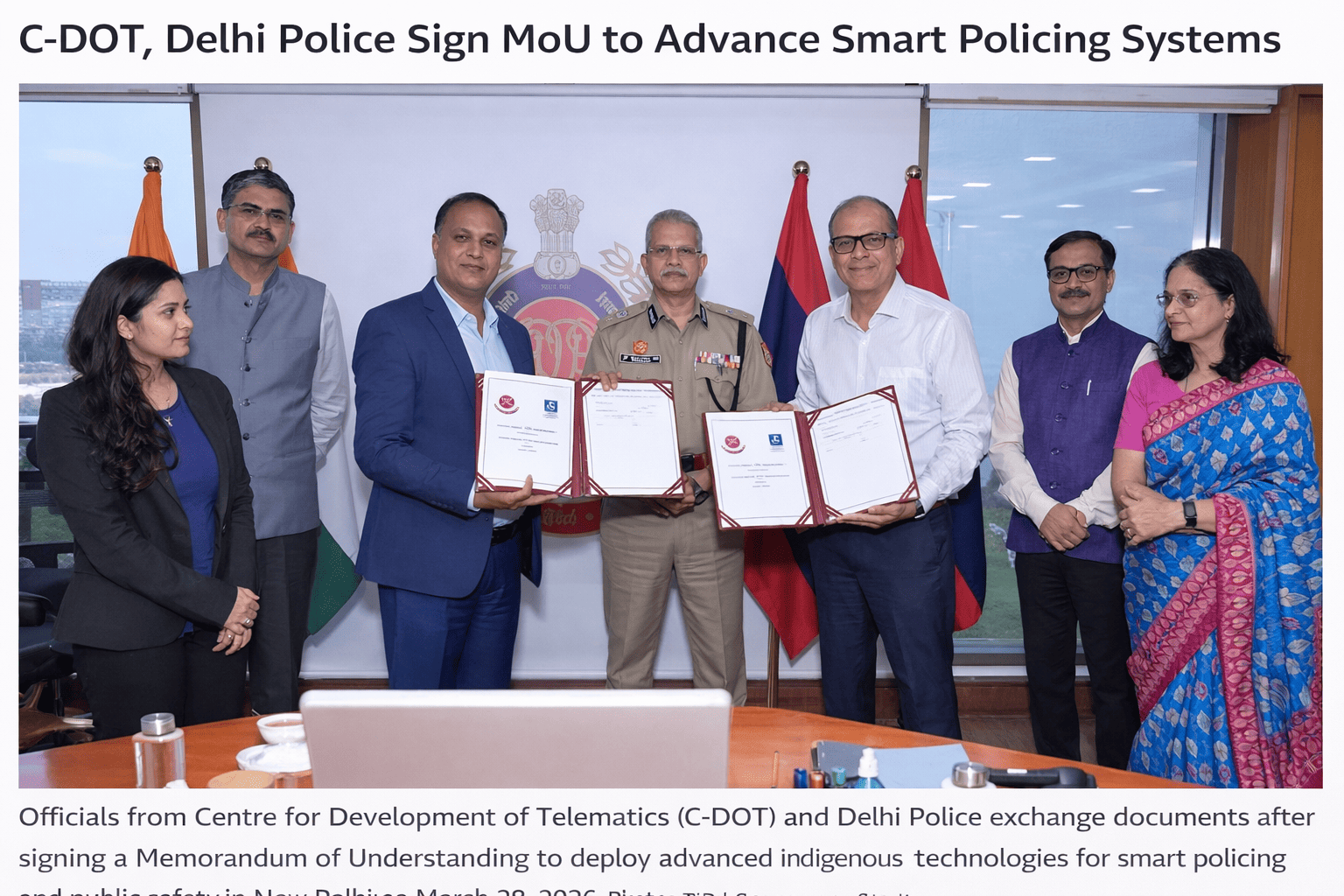
NEW DELHI — Centre for Development of Telematics (C-DOT) has signed a memorandum of understanding with Delhi Police to strengthen technology-driven policing in the national capital, marking a significant push toward secure, indigenous and future-ready law enforcement systems.
The collaboration, announced by the Department of Telecommunications, aims to integrate C-DOT’s suite of homegrown technologies into policing operations, enhancing capabilities in surveillance, secure communications, cybersecurity and emergency response.
Under the agreement, C-DOT will deploy nine advanced solutions tailored for modern policing needs. These include a facial recognition system to aid identification of suspects, missing persons and repeat offenders, and SAMVAD, a unified communication platform enabling secure messaging, voice and video coordination across police units.
A specialised version, SAMVAD Prime, will be used by senior officers for encrypted communications during critical operations, while C-DOT Meet, a secure video conferencing platform, will support briefings, training and inter-unit coordination.
For field operations and emergency response, the Mission Critical Services (MCX) platform will provide low-latency, secure communication among officers during large-scale events and disaster situations. Administrative efficiency is expected to improve through an AI-powered facial recognition-based attendance system.
The partnership also includes deployment of a cell broadcast solution for geo-targeted public alerts, covering traffic advisories, emergency warnings and missing person notifications.
On the cybersecurity front, Trinetra ESOC and Trinetra 360 platforms will monitor digital infrastructure, detect vulnerabilities and provide AI-driven threat intelligence. In a forward-looking move, quantum-based security tools such as encryption modules, secure video phones and quantum key distribution systems will be introduced to ensure future-ready, tamper-resistant communications.
C-DOT CEO Rajkumar Upadhyay said the partnership reflects a commitment to translating indigenous innovation into real-world impact, adding that the initiative will help build a “safer, smarter and more resilient” policing ecosystem aligned with the vision of Atmanirbhar Bharat.
Senior officials from both organisations, including Delhi Police leadership, said the collaboration could serve as a model for technology adoption in law enforcement across India.