

“I learnt to weave from my grandfather and father. But I won’t let my son become a weaver. There is nothing left in this business.” Mohammed Rizwan, a weaver from Nathnagar in Bhagalpur, Bihar, did not merely describe the hardships of his profession. In a few sentences, he captured the fear of an entire community: that a craft passed down through generations might end with the very people who have kept it alive.
Bhagalpur is still celebrated as the Silk City, known for its weaving skills and silk fabrics. Yet behind that identity lies an uncomfortable question. What happens when the people who sustain a tradition no longer want their children to inherit it?
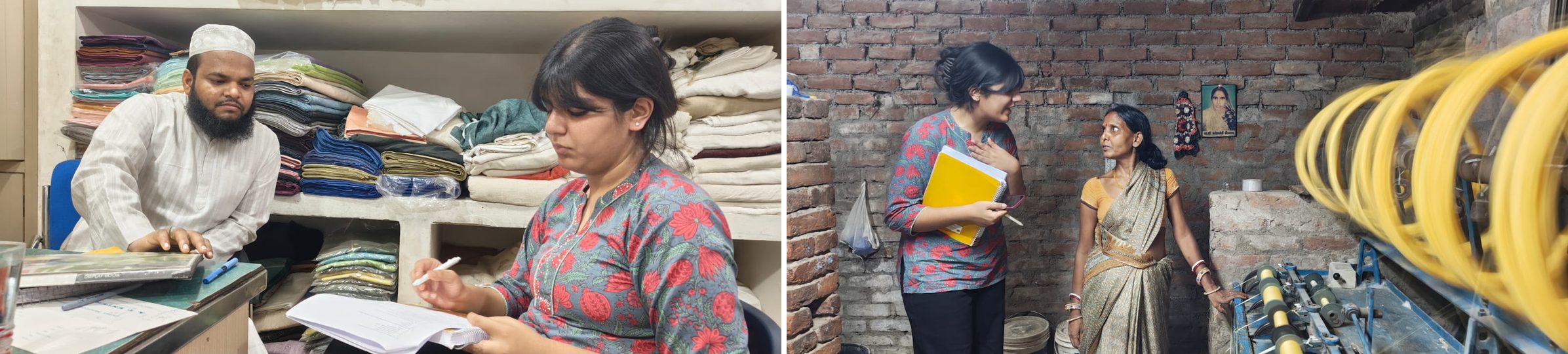
To understand this crisis, I surveyed 40 handloom and power loom weavers in Bhagalpur and 45 handloom weavers in the villages of Nuapatna and Maniabandha in Odisha’s Cuttack district between May and June 2026. The two weaving clusters are about 700 kilometers apart, but their experiences reveal more than differences in geography or technique. They show how the future of a traditional craft can depend on the systems built around the people who practice it.
The findings were striking. On a five-point scale, Odisha’s weavers rated their satisfaction with weaving at an average of four. Bhagalpur’s weavers gave it just 1.5. Only 4% of the Odisha respondents wanted their children to leave the craft. In Bhagalpur, nearly 80% wanted the next generation to pursue something else.
The grievances were remarkably similar in both places: low earnings and a disproportionate share of profits going to middlemen. The difference was hope.
In Odisha, weaving remains a livelihood that many families want to preserve. In Bhagalpur, it is increasingly seen as a profession from which the next generation must escape.
Trapped between speed and tradition
Bhagalpur’s crisis is not the result of a single problem. Its power loom and handloom sectors face different pressures, but both are struggling to secure a sustainable future.
Power loom weavers told me they were finding it difficult to compete with the high-speed, shuttleless looms used in Surat and textile hubs in southern India. Competing with industrial-scale production puts pressure on prices and leaves smaller units fighting for survival.
Some weavers said they had resorted to copying Tussar silk designs and selling the resulting fabric as handwoven to keep their businesses afloat. Such imitation creates another problem: it undermines the value of genuine handloom products and erodes the premium that skilled artisans once commanded.
Bhagalpur is thus caught in a difficult position. Its power loom units cannot easily match the scale and speed of larger industrial centers, while its handloom weavers struggle to protect the value of their craftsmanship. The city risks losing on both fronts: unable to compete on volume or consistently command a premium for authenticity.
What Odisha does differently
Odisha offers a revealing contrast. The state has spent decades building an ecosystem around its handloom industry, turning traditional weaving into a recognizable cultural and commercial identity.
Its Ikat sari is marketed as a heritage product, rather than simply another piece of fabric competing on price. Many of the weavers I met held Weaver ID cards that make them eligible for welfare benefits.
The state cooperative Boyanika provides another important link between artisans and markets. It recorded a turnover of ₹230 crore in the 2025-26 financial year, operates 41 exclusive outlets, maintains an e-commerce presence, and is affiliated with more than 600 primary weaver cooperatives, reaching over 40,000 weavers.
These institutions help connect production with marketing and distribution. They offer a framework through which traditional skills can reach customers while giving weavers a stronger collective presence.
Bihar’s support system, by comparison, remains fragmented. Institutions such as the Weavers’ Service Centre in Bhagalpur, UMSAS, Bihar Emporium and the Directorate of Handloom and Sericulture largely serve business-to-business needs. Bhagalpur lacks a comparable, integrated retail network that connects weavers directly with consumers.
As a result, artisans remain heavily dependent on middlemen and private buyers. Fragmented systems also make it harder to identify individual weavers, verify eligibility and ensure that welfare benefits reach those who need them.
Saving the loom means saving the livelihood
Bhagalpur does not lack weaving skills or machinery. What it lacks is the institutional support needed to turn those assets into reliable livelihoods.
A stronger cooperative network, a standardised retail chain and a robust online marketplace could help artisans reach buyers directly and retain a larger share of the final selling price. Better coordination among existing institutions could also improve access to welfare benefits and strengthen the market for authentic handloom products.
These changes will not automatically resolve every challenge. But without a system that rewards craftsmanship, protects authenticity, and improves earnings, appeals to preserve a centuries-old tradition may ring hollow.
Rizwan’s words remain the most telling finding of my survey. A father who learned weaving from his own family now wants his son to choose another path. His decision is not simply a rejection of tradition. It is a verdict on the livelihood that tradition has come to offer.
The future of Bhagalpur’s looms will not be decided by the skill of its weavers alone. It will depend on whether the institutions around them can make that skill economically worthwhile. For now, the Silk City still has its looms, its knowledge, and its artisans. But if the next generation sees weaving only as a struggle to survive, the silence that follows may be far harder to reverse than the decline that preceded it.
The writer is Class XII student at Heritage Xperiential Learning School, Gurgaon, Haryana