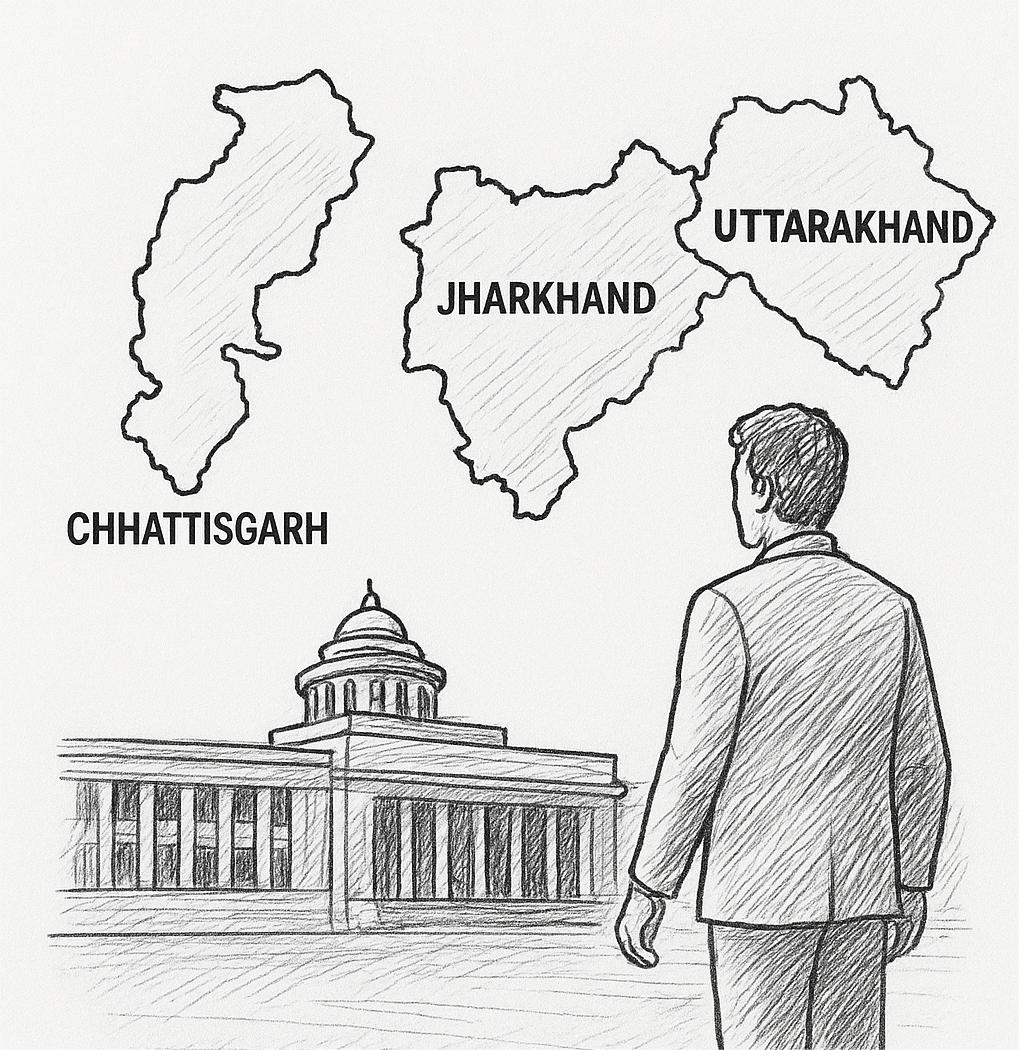
NEW DELHI — In November 2025, the Legislative Assemblies of Chhattisgarh, Jharkhand and Uttarakhand completed 25 years since their formation in 2000. A review of their functioning shows uneven legislative performance, long-standing structural gaps and several high-impact policy experiments that shaped national debates.
Between 2000 and 2025, the Chhattisgarh Assembly met an average of 29 days a year, while the Jharkhand Assembly met only 23 days annually. Comparable data for Uttarakhand is unavailable for most years between 2000 and 2015 and for 2025.
All three states currently have no Deputy Speaker — a constitutional position meant to strengthen legislative oversight. Jharkhand has operated without a Deputy Speaker for more than two decades, raising concerns over prolonged non-compliance with basic procedural norms.
Chhattisgarh stands out on representation, with women making up 21% of its present Assembly — higher than many states and significantly above the national average.
Across the three Assemblies, several major laws have left a lasting imprint. In 2002, Chhattisgarh enacted a law permitting private universities to be set up through a simple gazette notification, triggering a boom in higher-education institutions. Many of the over 100 universities existed largely on paper, prompting questions about quality and oversight. The Supreme Court struck down the enabling provisions in 2004. Chhattisgarh later enacted its own food security law in 2012, a year before Parliament passed the National Food Security Act.
Jharkhand was among the earliest states to legislate 75% reservation for local candidates in private-sector jobs, mirroring later laws passed in Andhra Pradesh and Haryana. These laws have faced constitutional challenges. Haryana’s version was struck down by the High Court in 2023, and the legality of similar provisions in other states remains unsettled.
Uttarakhand passed the Uniform Civil Code in 2024, becoming the first state since independence to enact such a law. The landmark legislation reignited national debates on personal laws and federalism.
As the three states mark 25 years of legislative functioning, the data highlights both institutional gaps — including low sitting days and key vacancies — and assertive lawmaking that has often tested constitutional boundaries.